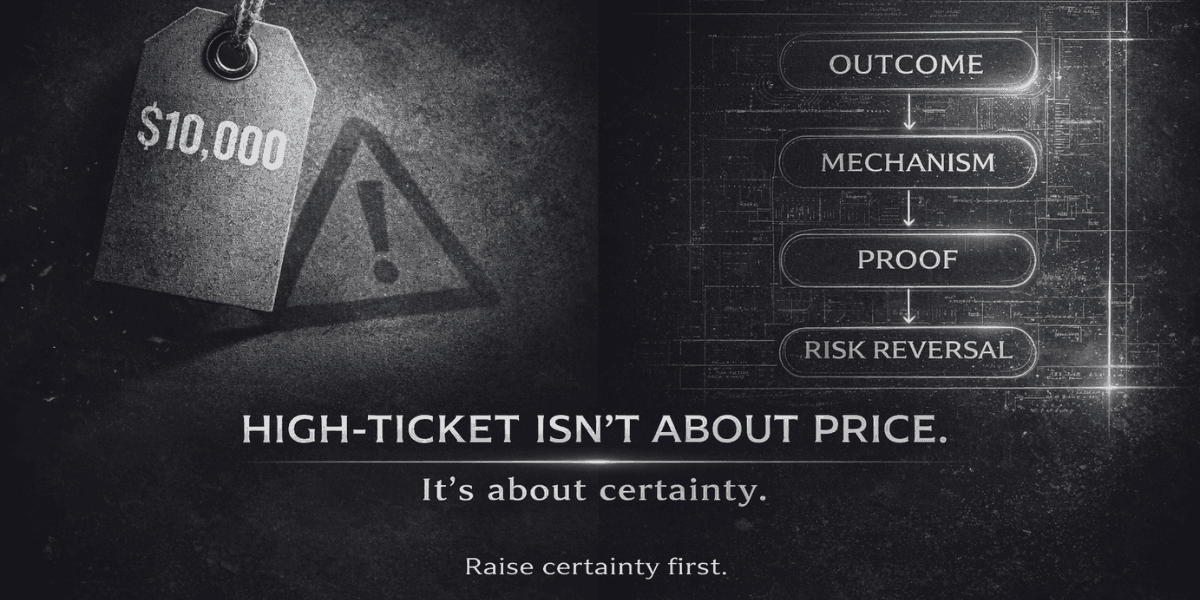

Raising your prices doesn’t make you premium. It makes you dangerous.
Dangerous to the buyer.
Because the moment you increase your price, you increase perceived risk.
And if the buyer’s brain senses risk without structure, it does what it’s designed to do: It protects itself.
This is why so many coaches “level up” their pricing… and quietly watch their sales pipeline dry up.They didn’t become premium. They became uncertain.High-ticket is not a pricing strategy. It’s a certainty strategy.
The Lie That’s Costing Coaches Millions
The coaching world loves this advice: “Just raise your rates. The right clients will pay.”
It sounds bold. Empowering. Alpha.It’s also incomplete.Price is not what attracts premium clients. Predictability does.When you raise your price without raising clarity, you’re not signaling value. You’re signaling volatility.And volatility is the opposite of what high-level buyers want.They don’t pay for hype. They pay for inevitability.
The Psychological Shift at Higher Price Points
At low-ticket, buyers think emotionally. At high-ticket, buyers think defensively.
- A $97 purchase asks: “Do I want this?”
- A $10,000 purchase asks: “Is this safe?”
The cognitive frame changes. At higher price points, the buyer is calculating:
- What’s the probability this works?
- What happens if it doesn’t?
- Is this structured or improvised?
- Do they have a real system, or just energy?
If you don’t engineer answers to those questions before they’re asked, resistance builds.
Not because your offer is bad. Because uncertainty is expensive.The Real Value Equation Most Coaches Ignore
Perceived value isn’t abstract. It’s mathematical:Most coaches obsess over increasing the “Desired Outcome.”
- Bigger promise.
- Bigger transformation.
- Bigger identity shift.
That’s when you hear:
High-Ticket Buyers Are Not Price-Sensitive
They are risk-sensitive.
They are not asking: “Can I afford this?”
They are asking: “Is this predictable?”
High-level clients understand leverage. They will happily pay $20,000 if they believe it saves them $200,000 in mistakes. They will invest heavily if they believe it compresses 18 months of chaos into 4 months of clarity.
But they will hesitate at $3,000 if it feels ambiguous.Certainty lowers resistance. Ambiguity amplifies it.
The 4 Layers of Certainty Engineering
Certainty is not personality. It’s architecture. If you want to sell high-ticket consistently, you must engineer certainty into your offer. Here’s how.
1 Transformation Specificity
“Scale your business” is not a transformation. “Step into your power” is not a transformation. High-ticket requires measurable shift.From what → to what. In what time frame. Under what conditions.
For example:- From inconsistent $5–8K months → stable $20K months within 6 months.
- From zero inbound leads → 3–5 qualified calls per week.
- From chaotic delivery → structured, repeatable onboarding system.
Specificity lowers ambiguity. Lower ambiguity lowers fear. Fear reduction increases buying velocity.
2 Mechanism Clarity
Most coaches sell access. High-ticket requires system.If your process sounds like: “We’ll get on calls and figure it out…” You’ve introduced uncertainty.Buyers want to see the path. Name your framework. Break it into phases. Define milestones.When someone sees the roadmap, their nervous system relaxes.Mystery builds intrigue. Structure builds trust. Trust closes high-ticket.
3 Proof Architecture
Testimonials are not proof. “Great coach. Highly recommend.” That does nothing at scale.High-ticket proof must dismantle skepticism. Effective proof answers:4 Risk Reversal or Strategic Filtering
At higher price points, one of two things must be true: You reduce risk. Or you reduce access.Risk reversal
- Milestone-based guarantees.
- Conditional refunds.
- Performance-based incentives.
Strategic filtering
- Strict application process.
- Clear disqualifiers.
- Explicit “this is not for beginners.”
Both increase perceived confidence. Both reduce perceived volatility.
When buyers feel chosen, not chased, price becomes less relevant.
Why High-Ticket Is Actually Easier
This is the irony.Low-ticket requires persuasion. High-ticket requires clarity.At low-ticket, you must create urgency. At high-ticket, you must create inevitability.When certainty is engineered correctly:- Sales calls become confirmations.
- Objections shrink.
- Buyers articulate their own reasons to move forward.
And alignment is far more scalable than pressure.
The Real Shift: From Access to Outcomes
Most coaches sell time. 8 calls. 12 weeks. Slack access. Voxer support.High-ticket clients don’t care about access. They care about outcome compression.They are buying:You are not charging $10,000 for calls. You are charging $10,000 to collapse 12 months of uncertainty into a predictable path.
When that is clear, price makes sense. When it isn’t, price feels aggressive.
Audit Before You Raise Your Price
Before you “go premium,” answer this:- Can you define your outcome in one measurable sentence?
- Can you explain your mechanism in 3 steps?
- Can a skeptic understand why it works?
- Does your proof mirror the buyer’s exact fear?
- Does your structure reduce perceived chaos?
Raise certainty first. Then raise price.
And something interesting happens. The right clients don’t hesitate. Because when transformation feels predictable, investment feels logical.
High-ticket isn’t ego. It’s engineered trust.
Want To Engineer Certainty Into Your Offer?
If you’re a coach or consultant struggling to close consistently at high-ticket, the problem is rarely sales skill. It’s offer architecture.
If you want help:
- Clarifying your transformation.
- Structuring your mechanism.
- Rebuilding your proof positioning.
- Designing an offer that reduces risk instead of amplifying it.
We’ll audit your current offer, identify where certainty breaks down, and rebuild it into something clients feel safe investing in. Let’s build something that sells itself.
Apply To Work With Me