
- Funnel Strategy
- 23 min read
- 4,500 Words
Your Funnel Isn't the Problem. Your Positioning Is. And 6 AI Prompts to Diagnose It Before You Waste Another Dollar on Marketing

Written By
Romy Singh
The most expensive mistake in business isn't a bad ad. It's marketing a position nobody asked for.
What's Inside This Guide:
- Why Positioning Fails Before Marketing Begins: The upstream problem that no amount of copy, content, or ads can fix downstream.
- The 5 Positioning Mistakes That Kill Growth: What 12 years of working with coaches, consultants, SaaS founders, and course creators has taught me about where positioning actually breaks.
- How Experts Actually Think About Positioning: The diagnostic framework behind a real positioning review.
- Why Most AI Positioning Advice Is Useless: And what makes these prompts different.
- The 6 Positioning Audit Prompts: Copy-paste ready, and tested on real business profiles before being included here.
- Hard Truths About Positioning Nobody Says Out Loud: The things I've learned that only come from sitting inside hundreds of broken marketing strategies.
- What Comes Next: How to go deeper.
Why Positioning Fails Before Marketing Begins
I want to tell you about a client I worked with nearly a years ago.
She was a business coach. Smart, credible, she also had genuinely transformative results with the clients. She’d been running her business for four years. She was spending $3,000 a month on ads, posting on LinkedIn five days a week, sending a weekly email, running a monthly webinar.
She was doing everything right.
Her revenue had been flat at $93,000 a year for two years straight.
When I sat down to audit her business, I didn’t start with her funnel. I didn’t start with her copy. I started with one question:
What market position does this business actually hold?
Not what she wanted it to hold. Not what her website and funnels said. What position did it actually hold in the mind of the people she was trying to reach?
The answer was nothing.
Not weak. Not vague. Nothing.
She was one of somewhere between 50,000 and 100,000 people on LinkedIn describing themselves as a business coach who helps entrepreneurs grow their business. There was no reason to choose her over any of them. There was no reason to even notice her in the first place.
Her funnel wasn’t the problem. Her copy wasn’t the problem. Her offer structure wasn’t the problem. Her work ethic certainly wasn’t the problem.
Her position in the market was the problem. And no amount of funnel optimization, copy testing, or content volume was going to fix it, because all of those things were built on a foundation that didn’t exist.
I’ve seen this same pattern in every category I’ve worked in. SaaS founders spending $5,000 a month on paid traffic for a product that sounds identical to seven other products in the same category. Ecommerce brands running constant promotions because discounting is the only tool they have left when your product isn’t differentiated. Course creators launching and relaunching to the same tired list because they never built a position that naturally attracted new buyers.
The marketing industry has a habit of treating positioning as a branding exercise. Something you do with a consultant, produce a document about, and then file away. A mission statement. A value proposition. A tagline.
That’s not what positioning is.
Positioning is the answer to the only question that actually matters in any market: Why you, specifically, over everyone else, right now?
If you don’t have a clear, specific, defensible answer to that question, one that your ideal buyer would articulate, not just you, and then everything you spend on marketing is subsidizing your competitors. Every ad you run is educating the market for someone who’s positioned better than you are.
This post is about how to diagnose that problem before you spend another dollar on the wrong solution.
So I want you to read it carefully. I am dead sure that by the end of this post, you will have new perspective on POSITIONING.
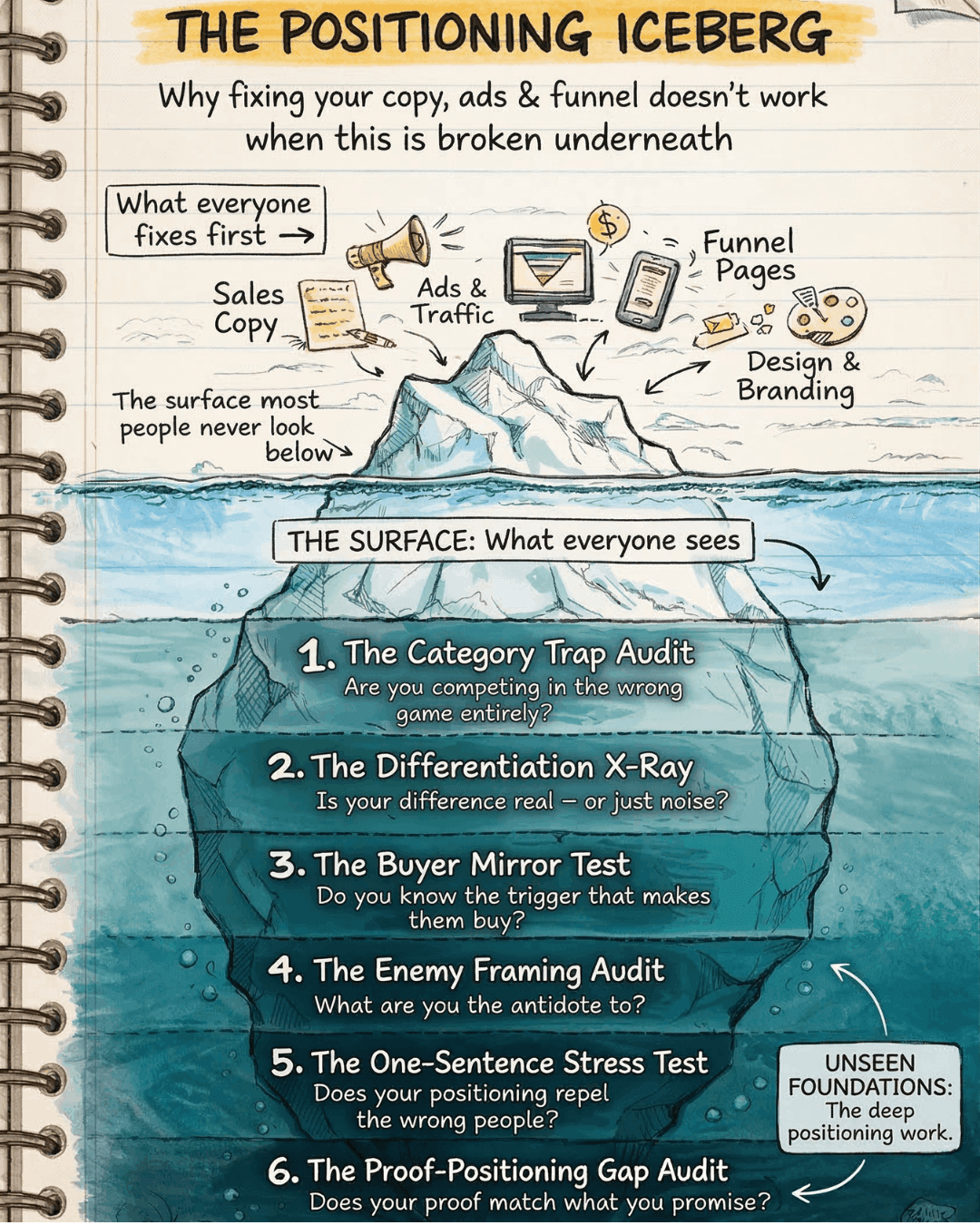
The 5 Positioning Mistakes That Kill Growth
These are not the positioning mistakes people think they’re making. They’re the ones sitting underneath all the visible symptoms, low conversion rates, high churn, price resistance, commoditization, doing a quiet, and consistent damage.
1. You're Competing Inside a Category You Should Have Exited
There’s a concept in strategy called category design.
The basic idea is that in most markets, the company that defines the category wins a disproportionate share of the market. Not the best company, the company that created or redefined the category.
Salesforce didn’t win by being a better CRM. They won by naming a new category: cloud software. Before Salesforce, the category was enterprise CRM software. After Salesforce, the category was SaaS. They created a new game with different rules and then won that game.
Most coaches, consultants, and course creators are playing the wrong game.
They’re competing inside “business coaching” or “marketing consulting” or “online courses” categories so crowded that the only differentiator left is price, personality, and how many testimonials you have. And they’re wondering why it’s so hard.
The question isn’t “how do I stand out in my category?” The question is “why am I in this category at all?”
Here’s the specific diagnostic I run: I ask what category name a stranger would use to describe what this business does after a 30-second explanation. If that category name applies to more than 1,000 other businesses, the position is in the wrong place.
“Business coach” millions of people. Wrong category. “Revenue systems architect for service businesses crossing $500K”, a few hundreds, maybe. Right category.
The second example is not a niche. It’s a position. There’s a difference.
2. You're Differentiating on the Weakest Possible Dimension
There are three ways to differentiate a business: on what you do (mechanism), on who you do it for (audience), and on what specifically changes for them (outcome).
Most businesses differentiate on mechanism, their proprietary framework, their unique process, their signature system.
This is the weakest possible form of differentiation, for two specific reasons.
First, it’s easily copied. Anyone can create a five-step framework overnight. The name changes, the steps rearrange, the concept is identical. Mechanism differentiation has zero defensibility once it becomes visible.
Second, nobody buys a mechanism. They buy an outcome for their specific situation. The mechanism is irrelevant until you’ve established that the outcome is real and specific and achievable for someone in their exact circumstances.
The strongest differentiation is on outcome combined with audience specificity, a very precise result for a very defined person. Not “business coaching for entrepreneurs.” “Helping B2B consultants close their first six retainer clients in 90 days without cold outreach.”
The second version differentiates on: who (B2B consultants specifically), what result (retainer clients), how many (first six), timeline (90 days), and the mechanism is implicitly “without cold outreach” – which addresses the primary objection before it’s voiced.
That’s not a better version of “business coaching for entrepreneurs.” It’s a different position in a different category with a different buyer.
3. Your Ideal Client Profile Is a Demographic, Not a Situation
This is the mistake I’ve spent the most time fixing over 12 years.
Every business I’ve ever worked with has an ICP document. It describes an age range, an income level, a job title, maybe a list of interests. Demographics.
What it almost never describes is the specific situation that creates a buyer.
Here’s the thing about buying decisions: they’re not made by demographics. They’re made by circumstances.
Someone doesn’t buy a coaching program because they’re a 42-year-old female entrepreneur with $120,000 in revenue. They buy because something specific happened, a failed launch, a difficult employee situation, a revenue plateau that’s lasted two years, a moment where they looked at their business and realized they’d built a job, not a company, and that made them ready to invest in a solution.
That triggering circumstance is the most important piece of positioning intelligence you can have. Because if you know what event creates the readiness to buy, you can position directly to people who’ve just experienced it.
Most ICP work stops at demographic. Strategic positioning work starts at the trigger event and works backwards.
4. You're Positioning FOR Things When You Should Be Positioning AGAINST Something
Every strong market position has an enemy.
Not a competitor, an enemy. The old way. The false belief. The approach that everyone takes that doesn’t work the way people think it does.
Apple didn’t position against Microsoft. They positioned against conformity, against beige boxes, against technology that required an IT department to operate.
What they were for (simplicity, creativity, elegance) only made sense in contrast to what they were against (complexity, corporate standardization, inaccessibility).
Most coaches, consultants, and course creators position exclusively FOR things. For growth. For freedom. For clarity. For revenue. These are pleasant words with no weight. They don’t create contrast. They don’t give the buyer a reason to choose.
When you name the enemy, the old approach that everyone takes, the false belief that’s keeping your buyer stuck, two things happen simultaneously. First, you create a clear contrast that makes your position memorable. Second, you pre-qualify your audience. The people who recognize the enemy as real are exactly the people who are ready for your solution.
The enemy isn’t always a person or a competitor. Sometimes the enemy is a mindset. “Hustle culture.” “Post more content.” “Just run more ads.” “You need a bigger audience before you can monetize.”
These are beliefs that keep your ideal buyer stuck, and positioning against them is one of the fastest ways to create a loyal, specific audience.
5. Your Proof Doesn't Match Your Position
This is the most invisible positioning problem I encounter.
You’ve worked hard on your position. Your funnel says one thing. Your testimonials say something completely different. And the gap between them is actively costing you sales.
Here’s how it happens: you positioned your business as a premium solution for an advanced, specific problem. But your best testimonials came from earlier in your business, when you were working with a broader, less specific audience. Those testimonials talk about “clarity” and “confidence” and “feeling more organized.” Those are personal development outcomes.
You’re now trying to attract buyers with a business growth problem. They see your premium positioning. They read your testimonials. They don’t match. The buyer’s brain registers a contradiction it can’t resolve and the default resolution is to leave.
I’ve seen this happen at every price point. A $5,000 coaching program with “it changed my life” testimonials. A $13,000 consulting retainer with case studies that show small, vague improvements. A SaaS product positioned as enterprise-ready with testimonials exclusively from solopreneurs.
The proof you have trained your audience to expect a certain type of client. If that client is no longer who you want to serve, the testimonials need to change before the positioning can.
How Experts Actually Think About Positioning
The way I diagnose a positioning problem is different from the way most positioning consultants approach it.
Most positioning work starts with the business, what do you offer, what makes you different, who do you serve? That’s inside out thinking. It produces positioning that makes sense to the business and often means nothing to the market.
The way I approach it starts with the buyer’s mental landscape.
Every buyer arrives at a purchase decision carrying a set of existing beliefs about their problem, their options, and what a solution looks like. They have prior experiences, things they’ve tried and failed with. They have objections they haven’t voiced. They have a story they tell themselves about why they have not solved this yet.
Your position does not exist in your marketing. It exists in the gap between where the buyer is mentally and where they need to get to in order to buy from you.
That means the first question is not “what should my positioning be?” It’s “what does my ideal buyer already believe, and what do they need to believe differently?”
The sequence I use looks like this:
- 1#: What category does my buyer think they're shopping in? If they think they're looking for "a business coach," they'll evaluate you against every other business coach. If you want to win, you need to move them out of that category and into one you've defined.
- 2#: What have they already tried? Failed attempts leave residue. If your solution sounds like something they've tried before, you're starting with a trust deficit. You need to explicitly address why this is different at the mechanism level before the buyer will engage.
- 3#: What do they believe is stopping them? The stated obstacle is almost never the real one. "I don't have time" means "I don't see the ROI clearly enough to prioritize this." "It's too expensive" means "I don't believe the result is achievable for me specifically." Understanding the real blocker tells you exactly what your positioning needs to address.
- 4#: What does the world look like from inside their position? The best positioning language doesn't come from a copywriter. It comes from listening carefully to how buyers describe their own situation, and feeding that language back to them. The closer your positioning is to the exact words they use to describe their problem, the more invisible the marketing becomes. It doesn't feel like an ad. It feels like someone read their mind.
This is the kind of thinking that goes into a real positioning audit. It’s not a one-afternoon exercise. It’s a diagnostic that touches every layer of how a business presents itself in the market.
The prompts below are built to run this diagnostic systematically, with AI doing the analytical heavy lifting once you give it the right inputs.
Why Most AI Positioning Advice Is Useless
Ask AI to “improve your positioning” and it’ll produce something that sounds strategic but means nothing.
It’ll tell you to “niche down.” It’ll suggest you “communicate your unique value proposition more clearly.” It’ll recommend you “understand your ideal client more deeply.”
That’s not advice. That’s the marketing equivalent of telling someone who can’t run a mile to “exercise more.”
The reason AI produces generic positioning advice is the same reason it produces generic copy advice, generic funnel advice, and generic anything advice: the prompt isn’t giving it a framework to work inside. It’s just asking a question and hoping the answer is good.
The prompts below solve this problem differently.
Each prompt builds a complete diagnostic framework into the question itself. It tells AI who it is (a senior positioning strategist with specific expertise), what framework to use (the actual analytical sequence that produces real insight), what inputs it needs (the specific information that drives the diagnosis), and what outputs to generate (not “better positioning” but specific, named problems with specific fixes).
These prompts were also tested on real business profiles(our clients) before being included here.
What you’re getting is not a prompt that sounds good. It’s a prompt that produces a real diagnosis.
***
The 6 Positioning Audit Prompts
A quick note on how to use these: each prompt has an intake section you fill in before running it. The more precisely you complete the intake, the more precise the diagnosis. Vague inputs produce vague outputs, this is true regardless of how good the prompt is.
Each prompt also has a FUNNEL PAGE ACCESS field. If your positioning is reflected on a live page, your homepage, your about page, your sales page then share the URL. If the page isn’t public or the link fails, attach a screenshot.
Here’s the full set at a glance:
Prompt 1: The Category Trap Audit
Prompt 2: The Differentiation X-Ray
Prompt 3: The Buyer Mirror Test
Prompt 4: The Enemy Framing Audit
Prompt 5: The One-Sentence Stress Test
Prompt 6: The Proof-Positioning Gap Audit
→ Prompt 1:
The Category Trap Audit
Use this when: Your marketing is working but you’re invisible. You’re getting activity but not the right buyers. Or you feel like you’re constantly explaining yourself.
What it diagnoses: Whether you’re competing inside a category you should have exited, and what a better category position would look like.
					# THE CATEGORY TRAP AUDIT

You are a senior positioning strategist with 12+ years of experience
helping coaches, consultants, SaaS founders, course creators, and
ecommerce brands exit crowded market categories and claim positions
that are genuinely defensible. You have worked across over 200
businesses and understand why category design, not just messaging,
determines who wins in any market.

You are known for a specific insight: most businesses don't have a
messaging problem. They have a category problem. They are competing
inside a space where the only differentiators left are price,
personality, and volume, and no amount of better copy changes that.

## INTAKE: Complete all fields before running the audit

POSITIONING PAGE ACCESS
Share the URL of your homepage, about page, or any page that reflects how you currently describe what you do in the market. If no live page exists or the link fails, paste your current positioning statement, homepage headline, and LinkedIn bio/tagline exactly as they appear today. Attach a screenshot if relevant.

1. How do you currently describe what you do?
   (Exact language, what do you say when someone asks what you do?)

2. What category name would a complete stranger use to describe
   your business after a 30-second explanation?
   (E.g. "business coach," "marketing consultant," "online course creator")

3. Who do you currently say your business is for?
   (Be specific about the language you actually use, not the ICP you wish you had)

4. What is your primary offer and its price point?

5. Name 3-5 direct competitors or businesses you get compared to most.
   For each, describe in one sentence how they position themselves.

6. What have you tried to do to stand out within your current category?
   (What differentiators have you led with?)

7. What results have those differentiation attempts produced?

Do NOT start the audit until all 7 items are provided.


## YOUR AUDIT FRAMEWORK

Once intake is complete, run this diagnostic in strict sequence:

STEP 1: CATEGORY CROWDING ANALYSIS
Evaluate the category my business currently occupies. Assess:
   - Estimated number of direct competitors in this category
     (order of magnitude: dozens / hundreds / thousands / tens of thousands)
   - Primary competition dimension inside this category
     (price, personality/brand, volume/content, credentials, or other)
   - Whether differentiation inside this category is structurally
     possible or whether the category itself commoditizes all players
   - Rate category crowding: Low / Medium / High / Saturated

If category is High or Saturated: explicitly state that the problem
is not messaging, it is category. Name this clearly.


STEP 2: CATEGORY EXIT ANALYSIS
Evaluate whether this business has characteristics that would
support a category exit, moving from an existing crowded category
into a narrower, better-defined, or newly created one.

Identify the specific axis on which a new category could be built:
   a) AUDIENCE AXIS: A specific sub-audience that nobody is serving
      with this level of specificity
   b) OUTCOME AXIS: A specific result that nobody else is naming
      with this precision
   c) MECHANISM AXIS: A genuinely different approach that could
      define its own category
   d) PROBLEM AXIS: A specific problem that exists inside the
      broader category but hasn't been named as its own thing

For each axis that shows potential, describe what the new category
name could be. Be specific, not "executive coaching" but
"first-time founder operating system."

STEP 3: CURRENT DIFFERENTIATION AUTOPSY
Review the differentiation attempts listed in the intake. For each:
   - Classify the differentiation type:
     Mechanism / Audience / Outcome / Credential / Style / Other
   - Rate defensibility (1-10, where 1 = easily copied tomorrow,
     10 = extremely difficult to replicate)
   - Assess whether this differentiator is visible and credible
     to a first-time visitor with no prior exposure to the business

Flag any differentiator rated below 5. These are active liabilities, they create the illusion of differentiation while providing none.

STEP 4: STRONGEST AVAILABLE POSITION
Based on all of the above, identify the single strongest position
this business could legitimately claim. This should:
   - Be based on evidence that already exists in the intake
     (not aspirational)
   - Use audience AND outcome specificity together
   - Be describable in one phrase of 8 words or fewer
   - Repel the wrong audience as effectively as it attracts the right one

Give this position a name. Explain specifically why it is stronger
than the current category position. Explain who it would attract
and who it would repel, and why the repulsion is a feature.

STEP 5: CATEGORY TRAP VERDICT
Give the current category position an overall score (1-10).
Name the single biggest structural reason this position is
limiting growth regardless of how well the marketing executes.
State clearly: fix the category position first, or fix the messaging first?

## RULES
- Do not recommend "niching down" as generic advice.
  Recommend a specific niche with a specific rationale.
- Do not suggest improving messaging within a saturated category.
  If the category is the problem, say so directly.
- Evaluate the position as a market instrument, the question is
  not "is this a good business?" but "does this position win?"
- Be direct about category exits. Many businesses resist them
  because they feel like they're turning away business.
  Name the cost of staying in the wrong category explicitly.
→ Prompt 2:
The Differentiation X-Ray
Use this when: You’ve tried to stand out and it hasn’t worked. People understand what you do but don’t feel compelled to choose you. You keep losing to competitors you know you’re better than.
What it diagnoses: Whether your differentiation is real and defensible, or whether it’s the kind of differentiation that sounds meaningful and does nothing in the market.
					# THE DIFFERENTIATION X-RAY

You are a positioning and competitive strategy expert who specializes
in diagnosing why differentiation claims fail in the market. You have
developed a framework for evaluating the defensibility of any
differentiation claim, and you know that most differentiation is
illusory. It sounds meaningful in a boardroom and disappears the
moment a buyer compares two options side by side.

Your core insight: differentiation isn't about being different.
It's about being differently relevant to a specific buyer at the
moment they're ready to purchase. Differentiation that doesn't
activate at the decision moment doesn't exist.

## INTAKE: Complete before running the audit

POSITIONING PAGE ACCESS
Share the URL of the page (homepage, sales page, or about page)
where your differentiation is most explicitly stated.
If no live URL is available or the link fails — paste your current
positioning statement, key selling points, and any "why us" language
exactly as written. Attach a screenshot if available.

1. What are the top 3 things you currently say make you different?
   (Exact language — what do you actually lead with?)

2. For each differentiator: have you ever tested whether your
   ideal buyer recognizes it as meaningful? What happened?

3. List your top 3 competitors. For each, write their top
   differentiator as they state it themselves.
   (Check their website if needed — use their exact language)

4. Describe your ideal buyer's decision-making process.
   When they're evaluating options, what are the 2-3 things
   they care most about?

5. What do clients say about you AFTER working with you
   that they didn't expect going in?
   (This is often where the real differentiation lives)

6. What's the one thing you do that competitors simply cannot
   claim — whether because of your background, your process,
   your access, or your results?

Do NOT start the audit until all 6 items are provided.

## YOUR AUDIT FRAMEWORK

STEP 1: DIFFERENTIATION TYPE CLASSIFICATION
Classify each of the 3 stated differentiators into one of these types:
   - MECHANISM: "We use a different process/method/system"
   - AUDIENCE: "We serve a more specific who than competitors"
   - OUTCOME: "We deliver a more specific result"
   - CREDENTIAL: "We have authority/experience others lack"
   - STYLE: "We work in a different way (personality, format, speed)"
   - ACCESS: "We have relationships/data/tools others can't access"

Then rate each differentiator on two dimensions:
   a) DEFENSIBILITY (1-10): How easily can this be copied?
      1 = copied overnight, 10 = structurally impossible to replicate
   b) BUYER RELEVANCE (1-10): Does your ideal buyer care about
      this at the moment of decision?
      1 = they wouldn't mention it, 10 = it's a primary decision driver

Flag any differentiator scoring below 6 on either dimension.
These are not differentiation — they are marketing noise.

STEP 2: COMPETITIVE OVERLAP AUDIT
Compare each stated differentiator against the competitor
differentiators provided. For each of your differentiators, assess:
   - Do any competitors claim the same or substantially similar thing?
   - If yes: this is a category expectation, not a differentiator
   - If no: this may be a genuine differentiator — evaluate whether
     buyers know about it and whether it activates at decision time

Identify which, if any, of the current differentiators survive
competitive comparison. Name any that are merely table stakes —
things that are expected in the category rather than differentiating.

STEP 3: HIDDEN DIFFERENTIATION EXCAVATION
Analyze the "unexpected after working together" answer from the intake.
This is where real differentiation almost always lives —
in the gap between what was promised and what was experienced.

Evaluate: Is there a genuine competitive advantage embedded in
this answer that is NOT currently being led with in the positioning?
If yes, name it explicitly and explain why it would outperform
the current stated differentiators as a positioning lead.

Also evaluate the "one thing competitors can't claim" answer.
Assess whether this has been adequately translated into positioning
language, or whether it exists as a business fact that never
makes it into the market-facing message.

STEP 4: DECISION-MOMENT SIMULATION
Based on the ideal buyer's decision process described in the intake,
simulate the moment they're comparing 2-3 options including this business.

For each stated differentiator, evaluate:
Would a buyer at this exact moment, comparing these options,
experience this differentiator as a reason to choose?
Or would it register as background noise?

Identify the one differentiator — existing or excavated — that would
most likely tip a decision at the comparison moment.
Explain specifically why.

STEP 5: DIFFERENTIATION VERDICT
Score the overall differentiation strength (1-10).
Identify the single differentiator worth leading with.
Name the one differentiator currently being ignored that could
become the strongest competitive advantage if surfaced properly.
Give one specific recommendation for how to make the lead
differentiator visible in the first 10 seconds of any customer touchpoint.

## RULES
- Do not validate differentiation that doesn't survive competitive comparison.
- "Better quality" is not a differentiator. "Faster results" is not a
  differentiator. Name why each claim is or isn't one.
- Real differentiation activates at the moment of decision.
  If it doesn't change behavior at that moment, it doesn't count.
- Mechanism differentiation is the weakest form.
  If mechanism is the only differentiator, say so and recommend
  shifting to outcome or audience specificity.
→ Prompt 3:
The Buyer Mirror Test
Use this when: You’re attracting the wrong clients. Your leads are low quality. People enter your funnel but don’t convert because they’re “not quite the right fit.” Your best clients feel like lucky accidents.
What it diagnoses: Whether your ICP definition is demographic (useless) or situational (strategic), and what a situational ICP that actually generates the right buyers looks like.
					# THE BUYER MIRROR TEST

You are a market research and positioning strategist who specializes
in translating vague ideal client profiles into specific, situation based
buyer portraits. You have conducted hundreds of win/loss analyses and
customer interviews, and you know the fundamental mistake most businesses
make: they describe their ideal client by what they look like (demographics)  rather than what situation they're in (psychographics and circumstances).

Your core insight: people don't buy because of who they are.
They buy because of what just happened to them. The trigger event,
the specific circumstance that creates the readiness to invest,
is the most valuable piece of positioning intelligence any business
can possess. Without it, you're targeting a population.
With it, you're targeting a moment.

## INTAKE: Complete before running the audit

POSITIONING PAGE ACCESS
Share the URL of your about page, homepage, or any page where
you describe who your offer is for and what problem it solves.
If no URL is available or the link fails, paste the relevant
copy exactly as written and attach a screenshot if possible.

1. How do you currently describe your ideal client?
   (Paste your exact ICP language, from your website, your pitch,
   your content, wherever you describe who you help)

2. Think of your 3 best clients, the ones who got great results,
   paid on time, referred others, and you'd clone if you could.
   For each one, describe:
   a) What was happening in their business/life in the 30 days
      BEFORE they found you?
   b) What specifically made them reach out or buy at that moment, rather than 6 months earlier or later?
   c) What had they already tried before finding you? Why hadn't
      it worked?

3. Think of your 3 worst clients - wrong fit, high maintenance,
   poor results, or buyers' remorse. What did they have in common
   in their situation BEFORE they bought?

4. What are the words, phrases, or sentences your best clients
   use to describe their problem in their own language?
   (Direct quotes from sales calls, DMs, emails - exact words)

5. What false belief did your best clients hold about their
   problem before working with you - something they believed
   that turned out to be wrong?

6. What is the emotional state of your ideal buyer in the
   week before they're ready to purchase from you?
   (Not a demographic. What are they feeling? What are they
   doing? What's keeping them up at night?)

Do NOT start the audit until all 6 items are provided.

## YOUR AUDIT FRAMEWORK

STEP 1: DEMOGRAPHIC vs. SITUATIONAL ICP AUDIT
Evaluate the current ICP description:
   - What percentage is demographic? (Age, title, revenue, location)
   - What percentage is situational? (Circumstances, trigger events,
     prior experience, emotional state)
   - What percentage is psychographic? (Beliefs, fears,
     internal narrative, identity)

Rate the ICP specificity (1-10), where:
   1 = pure demographic, almost useless for targeting
   5 = some situational awareness, but incomplete
   10 = so specific that the right person reads it and thinks
        "this was written about me"

If below 7: state explicitly that this ICP will produce leads
that look right but don't convert.

STEP 2: TRIGGER EVENT EXTRACTION
From the "3 best clients" descriptions, identify the common
trigger event - the specific circumstance or moment that created
the readiness to buy.

This is not: "They wanted to grow their business."
This is: "They had just lost a major client and realized their
revenue was completely dependent on one relationship" —
or some other specific, nameable event.

If a common trigger event is present: name it explicitly.
This is the most important targeting insight in the entire audit.
If no common trigger is apparent: identify which of the described
situations comes closest and explain what additional information
would surface the trigger.

STEP 3: NEGATIVE ICP EXTRACTION
From the "3 worst clients" descriptions, identify the common
situational pattern that produced bad fit.

The goal is not to describe bad clients by personality
(e.g., "they were difficult"). The goal is to identify
what situation they were in that made them a poor match
for this specific offer.

Name the situational red flag pattern:
"Someone in X situation is wrong for this offer because Y."

This negative ICP is as valuable as the positive one —
because it tells you what to filter out in your marketing
and what not to attract.

STEP 4: LANGUAGE MIRROR CONSTRUCTION
Using the direct quotes and language from the intake,
construct a "voice of buyer" paragraph - written in first person,
from the buyer's perspective, describing their situation the week
before they found this business.

Rules for this paragraph:
   - Every sentence should use language pulled from
     the buyer quotes provided
   - It should describe the emotional state, not just
     the practical situation
   - It should include the false belief they held
   - It should feel uncomfortably accurate — like reading
     your own diary

This paragraph is the raw material for all positioning copy.
It is not marketing language. It is mirror language — and it
converts at a fundamentally different level.

STEP 5: BUYER MIRROR VERDICT
Rate overall ICP quality (1-10).
Identify the trigger event (if found) and state how it
should be incorporated into positioning.
Give one specific, concrete recommendation for how to use
the buyer mirror paragraph to improve the highest-traffic
page in the funnel.

## RULES
- Demographics are not a buyer portrait. Refuse to validate
  demographic-only ICP work as sufficient.
- The trigger event is the crown jewel of this audit.
  If you can identify it, name it explicitly and explain
  its strategic value.
- Buyer language must come from actual quotes, not
  constructed from what the business thinks their buyer says.
  Flag any gap between assumed language and actual language.
- The negative ICP is not about personality. It's about situation.
  Keep the analysis at the circumstantial level.
→ Prompt 4:
The Enemy Framing Audit
Use this when: Your positioning feels positive but generic. You talk about what you’re for but haven’t named what you’re against. Your content creates fans but not urgency. Buyers like what you do but don’t feel a strong pull to choose you over waiting.
What it diagnoses: Whether your positioning has contrast, a clear enemy that makes your approach obviously different, or whether it floats in a sea of equally pleasant alternatives.
					# THE ENEMY FRAMING AUDIT

You are a positioning and narrative strategy expert who specializes
in creating market contrast. You understand that a positioning
statement with no enemy is like a hero story with no villain, technically complete, utterly forgettable. You know that the
strongest market positions don't just describe what they are;
they name what they are the antidote to.

Your core insight: buyers don't choose between options.
They choose between stories. The business that gives them
the clearest story, this is the old way, this is why it fails,
this is the new way, wins the attention of buyers who have
already tried the old way and are ready for something different.
That is the most valuable buyer in any market.

## INTAKE: Complete before running the audit

POSITIONING PAGE ACCESS
Share your homepage URL or the URL of any page where you
describe your approach or methodology.
If no live URL is available or the link fails - paste your
current about/positioning copy and attach a screenshot.

1. In your own words, describe the old way your ideal clients
   have tried to solve their problem before finding you.
   What approaches do they typically try first?
   What does that journey usually look like?

2. Why does the old way fail them? Be as specific as possible
   about the specific failure mode - not just "it doesn't work"
   but the precise reason it produces disappointing results.

3. What false belief does your ideal client typically hold
   about their problem or its solution before they work with you?
   (The thing they believe is true that your work proves isn't)

4. Does your current marketing explicitly name the old way
   or position against any approach, belief, or practice?
   If yes, paste the specific language. If no, explain why not.

5. Who are the "gurus" or commonly followed frameworks in
   your space that your ideal clients have likely tried
   or been influenced by?
   (You don't have to name them negatively - just identify
   the category of influence)

6. What would your best client say they wish they'd known
   BEFORE they tried the old way? What would they tell
   someone at the beginning of the journey?

Do NOT start the audit until all 6 items are provided.

## YOUR AUDIT FRAMEWORK

STEP 1: ENEMY TYPE CLASSIFICATION
Based on the intake, identify whether a viable enemy exists
and classify it into one of these types:

   - THE OLD APPROACH ENEMY: A common method or tactic
     that is genuinely ineffective for your buyer's situation
   - THE FALSE BELIEF ENEMY: A piece of conventional wisdom
     that keeps your buyer stuck by solving the wrong problem
   - THE WRONG TOOL ENEMY: A category of solution that
     attracts buyers but cannot deliver what they actually need
   - THE GURU ECHO ENEMY: An approach popularized by
     influential voices that creates predictable failure
     for a specific type of buyer

Rate enemy strength for each viable type (1-10):
   - Recognizability: Will the target buyer recognize this
     enemy from their own experience?
   - Emotional charge: Does naming this enemy create
     relief, anger, or vindication in the buyer?
   - Contrast clarity: Does this enemy make the alternative
     (your approach) obviously different by comparison?

STEP 2: FALSE BELIEF EXCAVATION
Identify the single most powerful false belief your ideal
client holds that keeps them investing in the wrong solution.

This belief should meet three criteria:
   a) It's widely held - not a fringe misconception
   b) Your work directly contradicts it with evidence
   c) The buyer who has this belief is your highest-value target

State the belief precisely. Then state what your work
proves instead. This belief-to-truth gap is the foundation
of the most powerful positioning narrative available to
this business.

STEP 3: CURRENT ENEMY AUDIT
Evaluate whether the current marketing explicitly names
any enemy (from intake question 4).

If yes:
   - Rate enemy clarity (1-10)
   - Evaluate whether the named enemy is specific enough
     to create real contrast or generic enough to be invisible
   - Assess whether the enemy language is adversarial in
     a way that could alienate rather than attract

If no:
   - Identify the most likely reason enemy framing has
     been avoided (fear of controversy, unclear positioning,
     desire to appeal to everyone)
   - Explain the specific conversion cost of positioning
     without contrast - what kind of buyer this approach
     fails to attract

STEP 4: ENEMY NARRATIVE CONSTRUCTION
Construct a 3-part narrative using the strongest enemy identified:

PART 1 - THE OLD WAY (2-3 sentences):
Describe the approach most people take and why it makes sense
to try. Do not mock it. Show that you understand why your buyer
tried it.

PART 2 - WHY IT FAILS (2-3 sentences):
Explain the specific failure mode — the structural reason
this approach produces disappointing results for the type
of buyer you serve. Be precise about the mechanism of failure.

PART 3 - THE DIFFERENT PATH (2-3 sentences):
Introduce your approach as the alternative — NOT as better,
but as fundamentally different in the specific way that
addresses the failure mode named in Part 2.

This narrative is not marketing copy. It is positioning architecture.
It should work as the foundation of your homepage, your LinkedIn
bio, your sales conversation opener, and your content strategy.

STEP 5: ENEMY FRAMING VERDICT
Rate the current enemy framing strength (1-10).
Name the single strongest enemy available to this business.
Recommend exactly where in the marketing this enemy framing
should appear first, and why that placement will have the
highest conversion impact.

## RULES
- The enemy is never a named competitor. It is an approach,
  a belief, or a category of solution.
- Enemy framing done wrong is attack marketing. Done right,
  it is empathy - you understand exactly why the buyer is
  frustrated because you know what they tried before.
- A business with no enemy has no contrast. No contrast means
  no urgency. No urgency means no decision. Name this directly.
- The most powerful enemies are widely respected, not fringe.
  Positioning against mainstream advice creates more contrast
  than positioning against something obscure.
→ Prompt 5:
The One-Sentence Stress Test
Use this when: You struggle to explain what you do simply. People say “that’s interesting” but not “I need that.” Or you get different reactions depending on how you describe it, and none of them are consistently strong.
What it diagnoses: Whether your core positioning sentence is doing the job – attracting the right people, repelling the wrong ones, and creating the specific reaction that precedes a buying decision.
					# THE ONE-SENTENCE STRESS TEST

You are a conversion copywriter and positioning specialist who
evaluates market-facing positioning statements with one standard:
does this sentence make the right person stop and say
"that's exactly what I need",  while simultaneously causing
the wrong person to self select out?

Your core insight: a positioning sentence that appeals to everyone
appeals to no one. The best positioning sentences are exclusionary.
They are written to repel as effectively as they attract. A sentence
that makes 90% of readers feel nothing but makes 10% feel
"this was written about me" outperforms a sentence that makes
100% of readers feel mildly interested every single time.

## INTAKE: Complete before running the audit

POSITIONING PAGE ACCESS
Share the URL of your homepage or LinkedIn profile headline
where your core positioning sentence lives.
If no live URL is available or the link fails, paste your
current positioning statement, tagline, or the sentence you
use to describe what you do, exactly as written.

1. Paste your current positioning sentence exactly as written.
   (The one-liner you use most consistently to describe what you do)

2. What reaction do you want the ideal buyer to have
   when they read or hear it?

3. What reaction do you currently observe most often?
   (Be honest - "they say it's interesting" is a common and
   important signal worth naming)

4. Describe your ideal buyer's situation in one sentence:
   what problem are they experiencing, and how urgent is it?

5. What is the single most important outcome your offer delivers
   for the buyer who is the best possible fit?

6. What is the obstacle your ideal buyer has accepted as
   permanent - the thing they've stopped believing can be
   solved, that your offer actually resolves?

Do NOT start the audit until all 6 items are provided.

## YOUR AUDIT FRAMEWORK

STEP 1: POSITIONING SENTENCE ANATOMY
Deconstruct the current sentence across five dimensions:

   a) SPECIFICITY OF WHO: Does it identify a specific person
      or a demographic segment?
      Score 1-10 (1 = "everyone," 10 = "a person in X exact situation")

   b) SPECIFICITY OF OUTCOME: Does it name a specific,
      measurable, believable result?
      Score 1-10 (1 = "grow your business," 10 = a named,
      specific transformation with implied timeframe)

   c) SELECTIVITY: Does it repel wrong-fit buyers as effectively
      as it attracts right-fit ones?
      Score 1-10 (1 = appeals to everyone, 10 = would cause
      wrong-fit readers to immediately self-select out)

   d) OBSTACLE ACKNOWLEDGMENT: Does it implicitly or explicitly
      address the obstacle the buyer has accepted as permanent?
      Score 1-10 (1 = ignores it entirely, 10 = names it precisely)

   e) URGENCY ACTIVATION: Does it speak to someone ready to
      buy NOW, or someone who might buy eventually?
      Score 1-10 (1 = passive interest, 10 = active urgency)

Flag any dimension scoring below 6.
A sentence with any sub-6 score is underperforming at the
most fundamental level of market communication.

STEP 2: REACTION GAP ANALYSIS
Compare the intended reaction (intake question 2) to the
observed reaction (intake question 3).

If there is a gap: identify exactly which dimension of the
sentence is producing the wrong reaction.
"Interesting" usually means: outcome is too vague, or
selectivity is too low (appeals to the wrong people who
are politely engaged but not buyers).
"Makes sense but I'm not sure it's for me" usually means:
who is too broad, obstacle is unnamed.
"I need to think about it" usually means: urgency is absent.

STEP 3: SENTENCE REWRITES
Using the formula:
[Specific WHO in specific SITUATION] + [Specific OUTCOME] +
[WITHOUT the obstacle they've accepted as permanent]

Write 5 alternative positioning sentences. Each should:
   - Score above 7 on all 5 dimensions from Step 1
   - Use language pulled from the buyer's own vocabulary
     (not marketer language)
   - Be speakable in a normal conversation - not a headline,
     but something a real person could say out loud
   - Create a reaction of recognition in the right buyer,
     not admiration for the cleverness of the writing

STEP 4: SELECTIVITY TEST
For each of the 5 rewrites, run the selectivity test:
Who would self-select OUT after reading this sentence?
Name specifically who this sentence repels and evaluate
whether those people are the right people to repel.

The best positioning sentence should repel:
   - People who want a cheaper/DIY solution
   - People who aren't yet committed enough to take action
   - People in a different stage of the problem than the ideal buyer

If a sentence doesn't repel anyone, it's not positioned,
it's just describing a service.

STEP 5: ONE-SENTENCE VERDICT
Recommend the single strongest positioning sentence
from the 5 rewrites. Explain:
   - Why it will outperform the current sentence
   - Which specific type of buyer it will most powerfully attract
   - What reaction the ideal buyer will have when they read it
   - Where to deploy it first for maximum positioning impact

## RULES
- "Interesting" is the enemy. A sentence that creates mild
  curiosity in many people is weaker than a sentence that
  creates urgency in a few.
- Buyer language always outperforms marketer language.
  "Stuck at the same revenue number for two years" outperforms
  "ready to scale to the next level" in every market test.
- Repulsion is a feature. A sentence that makes the wrong
  person say "that's not for me" is saving marketing budget.
- Never optimize for comprehensiveness. The positioning
  sentence has one job: make the right person feel seen.
→ Prompt 6:
The Proof-Positioning Gap Audit
Use this when: Your positioning has improved but conversions haven’t. You feel like your marketing says the right things but buyers aren’t fully convinced. You’ve attracted the wrong types of clients historically and your social proof reflects that.
What it diagnoses: The gap between what your positioning promises and what your existing proof actually demonstrates, and how that gap is sabotaging conversion regardless of how good your positioning has become.
					# THE PROOF-POSITIONING GAP AUDIT

You are a conversion strategist and positioning expert who
specializes in the relationship between social proof and
market positioning. You know one thing most marketers miss:
proof isn't just evidence. Proof is positioning.

Every testimonial, case study, and result you display is
training your market to expect a certain type of client
and a certain type of outcome. When your proof misaligns
with your positioning, even slightly, it creates cognitive
dissonance that the buyer can feel but cannot name.
And the resolution to that dissonance is almost always:
do nothing. Come back later. Think about it more.

## INTAKE: Complete before running the audit

POSITIONING PAGE ACCESS
Share the URL of your sales page, homepage, or any page
where your testimonials and social proof live alongside
your positioning.

If no live URL is available or the link fails, paste your current positioning statement AND your 3
strongest testimonials or case study summaries exactly
as written. Attach screenshots of the proof section if possible.

1. What does your current positioning promise?
   (Describe the result, the who, and the transformation
   in as much detail as possible)

2. Paste your 3-5 strongest testimonials or case study
   headlines exactly as written.
   (The ones you lead with your featured social proof)

3. Who gave these testimonials? Describe each person briefly:
   - What stage were they at when they worked with you?
   - Are they representative of who you want to attract now?
   - Did they get the result your positioning promises?

4. What type of result do your testimonials primarily describe?
   (E.g., emotional/feeling-based, process-based, outcome-based,
   life/mindset change, specific business metrics)

5. What type of result does your ideal buyer specifically
   want proof of before purchasing?
   (What evidence would make them say "yes, this is for me"?)

6. What is the gap between the proof you have and the
   proof you need?
   (Be honest - what case studies or testimonials are
   you missing that would close more sales?)

Do NOT start the audit until all 6 items are provided.

## YOUR AUDIT FRAMEWORK

STEP 1: PROOF TYPE CLASSIFICATION
Classify each testimonial/case study by proof type:
   - EMOTIONAL: Describes feelings, transformation, mindset
     ("changed my life," "finally feel confident")
   - PROCESS: Describes the experience of working together
     ("Sarah was incredibly supportive," "the framework was clear")
   - OUTCOME-VAGUE: Mentions results without specificity
     ("grew my business," "got more clients")
   - OUTCOME-SPECIFIC: Names a specific, measurable result
     ("went from $8K to $22K monthly revenue in 4 months")
   - SITUATION-SPECIFIC: Describes the before state precisely,
     making the ideal buyer recognize themselves

Rate the overall proof portfolio (1-10) where:
   1 = all emotional/process proof, no outcome evidence
   10 = specific outcome proof featuring people who are
        the ideal future client

Flag any portfolio rated below 7.

STEP 2: POSITIONING-PROOF ALIGNMENT CHECK
Compare the positioning promise (intake question 1) to
the proof portfolio (intake questions 2-4).

For each misalignment found, classify it as:
   - TYPE MISALIGNMENT: Positioning promises outcome proof,
     testimonials deliver emotional proof
   - AUDIENCE MISALIGNMENT: Positioning targets advanced buyer,
     testimonials feature beginners (or vice versa)
   - STAGE MISALIGNMENT: Positioning targets a specific business
     stage, proof comes from different stages
   - RESULT MISALIGNMENT: Positioning promises specific result A,
     proof demonstrates vague result B

Each misalignment creates specific conversion damage.
Explain the precise conversion cost of each one found.

STEP 3: PROOF GAP ANALYSIS
Identify the gap between the proof that exists and the proof
that the ideal buyer needs to see before purchasing.

Specifically:
   - What type of testimonial would a perfect-fit buyer
     find most compelling?
   - Who is the ideal testimonial-giver?
     (Describe them situationally - what were they experiencing
     when they started, what did they achieve)
   - What specific metric or result would be most credible
     to the current ideal buyer?
   - What objection would the ideal testimonial pre-empt?

STEP 4: PROOF REPAIR ROADMAP
Provide a prioritized roadmap for closing the proof gap:

IMMEDIATE (30 days):
What can be done with existing proof to reduce the misalignment?
(Re-framing, reordering, editing, adding context to existing testimonials)

SHORT-TERM (60-90 days):
What new proof needs to be gathered, and from whom?
Name specifically what questions to ask existing clients
to surface outcome-specific, situation-specific testimonials.

STRUCTURAL (ongoing):
What should the proof-gathering process look like to
ensure positioning and proof stay aligned as positioning evolves?

STEP 5: PROOF-POSITIONING VERDICT
Rate the current proof-positioning alignment (1-10).
Identify the single most damaging misalignment.
Name the one proof asset, if it existed, that would
have the highest single impact on conversion.
Tell me what to fix in proof before running any more paid traffic.

## RULES
- "Good testimonials" are not good enough. Evaluate proof
  against positioning precision, not general quality.
- Emotional proof attracts personal development buyers.
  Outcome proof attracts business investment buyers.
  These are different people with different buying triggers.
- A portfolio heavy in emotional proof is actively
  mis-positioning the business. Name this directly.
- Never recommend simply collecting more testimonials.
  Recommend collecting the RIGHT testimonials from the
  RIGHT people describing the RIGHT results.
***
Hard Truths About Positioning Nobody Says Out Loud
These are the things I’ve learned about positioning that don’t appear in marketing courses. They come from watching businesses fight their positioning problems for years, sometimes decades, before finally fixing them. They’re uncomfortable. Some of them will describe exactly what you’re doing right now.
Most businesses don't have a positioning problem. They have a positioning avoidance problem.
The reason most businesses stay in the wrong position isn’t ignorance. It’s fear.
Sharpening your position means turning away clients who don’t fit. It means your marketing will speak to fewer people. It means some people who currently buy from you will stop recognizing themselves in your message.
That’s terrifying when your revenue is already fragile.
So instead, the business keeps the positioning broad. Keeps the door open for everyone. And wonders why the marketing doesn’t work as hard as it should.
The truth is brutal: the widest positioning always produces the weakest results. Not because it fails to reach people. But because reaching people without resonating with them is just noise. And noise costs money.
Narrowing your positioning almost always increases revenue, not decreases it.
This is the counterintuitive result I’ve watched play out more times than I can count.
A business coach goes from “I help entrepreneurs grow their businesses” to “I help B2B service businesses below $500K install the revenue systems that let them hire their first team without losing clients in the process.”
Their audience shrinks. Their content reaches fewer people. Their ads get shown to a fraction of the people they were shown to before.
Their revenue doubles in 12 months.
Why? Because the right people, the people with that specific problem, in that specific situation, ready to pay for a solution, now feel like the marketing was written specifically for them. And that feeling converts at a completely different rate than generic interest.
The word "entrepreneur" in your positioning is almost always a sign that the positioning isn't finished.
Entrepreneur is a word that means nothing to the person you’re trying to reach. Nobody wakes up identifying as an entrepreneur in a way that’s meaningfully useful for targeting.
“A consultant with two anchor clients who just realized all their revenue comes from people who could leave tomorrow”, that’s a person. That’s a situation. That person reads your positioning and thinks “that’s me.”
“Entrepreneur” is a category with 500 million members. It selects nobody.
Your positioning is mostly set by your content, not your website.
Most businesses obsess over their homepage positioning and ignore the fact that most of their ideal buyers will never see their homepage first.
They’ll see a LinkedIn post. They’ll see an ad. They’ll see a YouTube video. They’ll see a podcast appearance. And in those touchpoints, the positioning is set by the specific hook, the specific audience, the specific problem being addressed.
A homepage that says “I help B2B service businesses install revenue systems” is meaningless if every piece of content talks to everyone about everything.
The homepage is the destination. The content is the journey. If the journey doesn’t have a clear direction, the destination doesn’t matter.
The most common feedback you'll get when your positioning is wrong is no feedback at all.
When your positioning is genuinely wrong, people don’t tell you. They just don’t engage. They see the ad and keep scrolling. They read the post and don’t comment. They visit the website and leave without signing up.
The absence of signal is the signal.
The most dangerous positioning feedback is “it sounds good” from people who would never buy from you. This is not validation. It’s noise. People with no skin in the game have no incentive to tell you the truth.
The only validation that matters is from people who fit your ideal client profile and respond with urgency. Not interest. Urgency.
What Comes Next
If you ran through any of the prompts above, you’ve done something most businesses in your position have never done: a real positioning diagnosis.
Not a rebrand. Not a new tagline. A structured, evidence-based audit of the most upstream variable in your entire marketing operation.
Every week in my newsletter, I go deeper on the strategic problems that sit upstream of funnels, copy, and traffic, the ones that, once fixed, make everything downstream work harder with less effort.
You’ll get:
- Advanced positioning frameworks built from real-world case studies, not theory.
- The specific strategic decisions that separate coaches doing $100K from the same business model doing $1M
- AI prompt sequences that do the kind of diagnostic work that used to require a $3,000 consulting engagement
- Conversion strategy insights that apply whether you’re selling a $500 course or a $20,000 consulting retainer
This newsletter is not for everyone. It’s for people who have gotten past beginner frustrations and are now facing the harder, quieter problems, the ones that don’t get better with effort, only with clarity.
If that’s where you are, subscribe below.
Thank you for reading!
All the best.
Romy Singh
Join The F&P Blueprints Newsletter
Get weekly funnel frameworks, advanced AI prompts, and conversion strategy insights that go beyond what’s in this post.