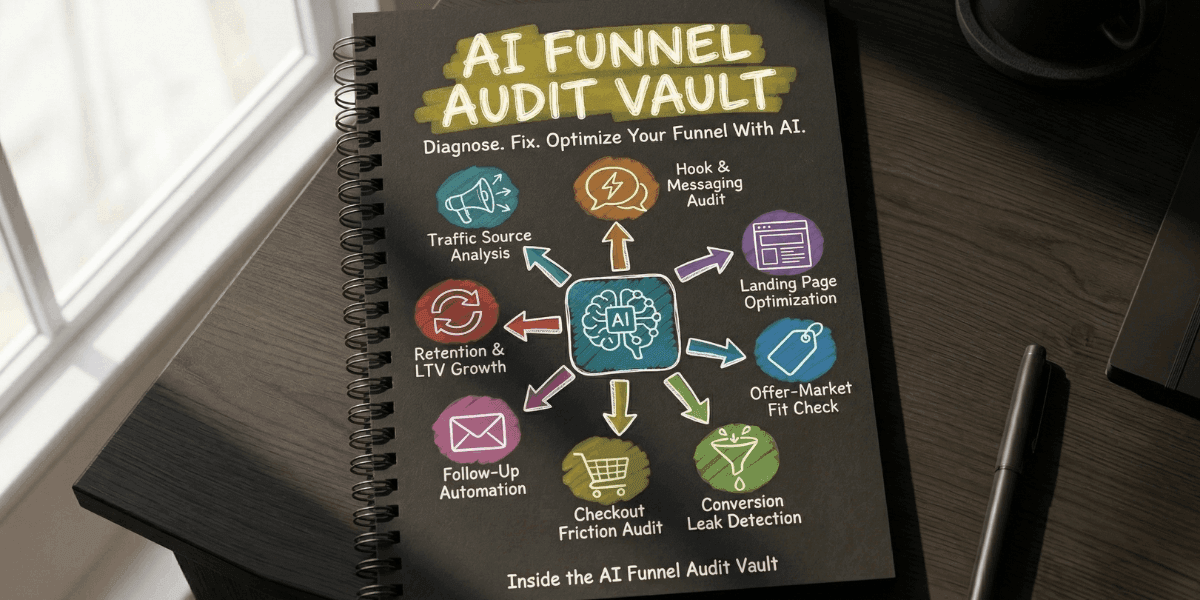

🔒 Subscriber-only post!
8,700 words | 41-min read | 8 copy-paste AI prompts included. If your funnel isn't converting and you've already fixed the copy, what's inside is exactly what you need to read next.
Most funnels don’t fail because of bad traffic. They fail because nobody ever diagnosed the real problem.
What’s Inside This Guide:
- The Real Reason Funnels Fail – Why traffic is not your problem.
- The 7 Hidden Problems Inside Most Funnels – What experienced strategists catch that everyone else misses.
- How Experts Actually Audit a Funnel – The diagnostic thinking framework behind a real funnel review.
- How to Use AI as a Strategic Thinking Partner – Why AI gives generic advice, and how the right prompts change everything.
- The AI Funnel Audit Vault (8 Prompts) – Copy&paste ready prompts, each named for what it diagnoses.
- Hard Truths From 320+ Funnel Audits – Non obvious lessons that only come from sitting inside hundreds of broken funnels.
- What Comes Next – How to go deeper and get the full conversion framework.
The Real Reason Funnels Fail
Here’s something I’ve learned after auditing over 320 funnels across coaching, consulting, and digital product businesses:
Most people are solving the wrong problem.
They come to me frustrated. Funnel’s not converting. Ads are bleeding money. Lead magnet downloads are up but sales are flat. They’ve rewritten the copy three times. They’ve hired a designer. They’ve added a VSL.
And none of it moved the needle.
The reason is almost always the same. They’re patching symptoms while the root cause sits untouched.
Here’s what I mean.
When a funnel does not convert, most people jump to the most visible layer, the copy. They rewrite headlines, CTAs. They tweak the offer stack. They add scarcity timers and bonus bundles. These are all cosmetic changes on what is often a structural or strategic problem.
It’s like adding a fresh coat of paint to a house with a cracked foundation. The paint looks great. But the house is still sinking.
After hundreds of audits, I’ve come to see funnel failure as almost always falling into one of a handful of root causes. Not copy problems. Not design problems. Not even traffic problems. Strategic problems.
Problems that live upstream of your funnel pages, in your positioning, your offer architecture, your hook, your awareness targeting. Problems that no split test will ever fix, because you can’t optimize your way out of a wrong strategic direction.
This post is going to show you how I actually think when I sit down to diagnose a sales funnel. The frameworks I use. The questions I ask. And then, because AI has made this kind of deep thinking available to everyone, I’m going to give you 8 Funnel AI prompts you can use right now to run the same diagnostic on your own funnel.
Not generic prompts. Not “ask AI to review your copy” prompts.
Prompts that force AI to think like a strategist with 12 years of funnel experience, not a writing assistant.
Let’s start with what’s actually wrong.
The 7 Hidden Problems Inside Most Funnels
These are the problems I find most consistently across audits. They’re not the problems people think they have. They’re the ones sitting quietly underneath everything else, causing the real damage.
1. Offer-Market Mismatch
This is the most common root cause I see, and the most underdiagnosed.
The offer sounds good. It’s priced reasonably. The creator knows their stuff. But it’s not selling.
Why? Because the offer is built around what the creator wants to deliver, not what the market is desperately trying to buy.
There’s a specific thing people misunderstand about offer construction. The offer is not just your product. It’s the specific transformation you’re promising, the timeline you’re attaching to it, and the mechanism you’re claiming is different.
If your offer sounds like something the buyer has tried and failed at before, even if your mechanism is genuinely different, it will not convert. The market has already written a mental story about why that result isn’t possible for them. Your offer needs to break that story, not confirm it.
Most offers I audit sound like a better version of something that already exists. They compete on quality. That’s a losing game.
The offers that convert in cold traffic give people a specific reason to believe that this approach is different, that the old obstacles don’t apply, and that the result is achievable for someone in their exact situation.
2. Hook-Audience Misalignment
Your hook is doing something most people don’t realize: it’s selecting an audience.
Every hook filters people in and filters people out. The wrong hook attracts the wrong people, people who are curious but not ready to buy, people who are in earlier stages of awareness, people who want the free version of what you’re selling.
The most common hook mistake I see is what I call “teaching hooks.” They lead with insight or information. They attract learners, not buyers.
“3 mistakes stopping coaches from scaling” is a teaching hook. It attracts people who want to learn. It does not attract people who are in active pain and looking for a solution right now.
Compare that to something like: “I used to charge $500 a month. I now charge $10K. Here’s the single reframe that made the difference.”
That’s a different conversation entirely. That’s a hook for someone who already knows they should be charging more, who is frustrated that they haven’t cracked it yet, who is one conversation away from being ready to buy.
The hook determines who reads the rest of your funnel. Get the audience wrong at that stage, and you’ll convert nobody, even if everything downstream is excellent.
3. Awareness Level Targeting
Eugene Schwartz wrote about this in 1966. Marketers still get it wrong in 2026.
Every prospect exists somewhere on an awareness spectrum. At one end, they don’t know they have a problem. At the other end, they know exactly what they want and they’re comparing options.
The mistake I see constantly is funnels written for one awareness level being sent to audiences at a completely different level.
A warm email list gets the same VSL written for cold Facebook traffic. A cold ad audience lands on a long-form sales page that assumes they already understand the problem and believe in the solution. A podcast listener who’s been following you for a year gets a webinar funnel designed for strangers.
The friction this creates is invisible. Nobody can name it. But the buyer feels it. The funnel feels “off.” The ask comes too soon, or the education goes on too long. The prospect abandons the page without knowing why.
Awareness targeting is one of the highest-leverage variables in funnel performance. When it’s right, even mediocre copy converts. When it’s wrong, even brilliant copy stalls.
4. Funnel Architecture Gaps
Most funnels I audit are incomplete.
Not in terms of pages, they have pages. They’re incomplete in terms of the psychological journey they take the prospect through.
A properly structured funnel moves someone through a sequence of micro commitments. Each stage of the funnel has one job: earn the right to ask for the next commitment.
What I usually find is a funnel where the stages are out of order, or stages are missing entirely.
An opt-in page that asks for an email before the visitor has any reason to give it. A sales page that presents the offer before it’s established credibility. A checkout page that creates friction at the moment of maximum buying intent. A VSL that covers benefits before it’s addressed the core objection.
Each of these is a friction point. Each one causes drop offs that gets blamed on bad copy or bad traffic. In reality, the architecture was broken from the start.
5. Lead Magnet Positioning Failure
This one is subtle and deadly.
Your lead magnet doesn’t just have to be valuable. It has to attract people who are the right distance from your paid offer.
The most common lead magnet mistake is a massive gap between the free content and the paid solution.
You give away a 40-page guide on “how to start a podcast.” Then you try to sell a $2,000 program on “how to monetize your podcast.” The people who downloaded the guide are in the research phase. They haven’t even started yet. Your offer is for people who are already doing it and stuck.
The lead magnet positioned your offer to the wrong audience. And no amount of email nurture fixes that misalignment.
A well positioned lead magnet accomplishes something very specific: it filters for people who already have the problem your paid offer solves, it demonstrates the gap between where they are and where they want to be, and it positions your offer as the most logical next step, not a leap.
6. Call-to-Action Failure Modes
Most CTAs fail in one of three ways.
They’re too vague (“Learn more”).
They’re too aggressive for the level of trust established (“Buy now” on a cold traffic page).
Or they’re competing with other CTAs on the same page, creating decision paralysis.
But there’s a fourth failure mode that almost nobody talks about: the CTA doesn’t match the buyer’s internal language.
Buyers have a voice in their head describing what they want. When your CTA matches that voice, it feels like it was written for them. When it doesn’t, there’s a subtle disconnect they can’t name, and they don’t click.
“Start your transformation” is marketer language. Nobody wakes up saying they want to start a transformation.
“Get my first paying client this week” is buyer language. That’s what they actually want. That’s what they say to themselves at 2am when they can’t sleep.
CTA language is one of the highest leverage, lowest effort fixes in any funnel. But finding the right language requires understanding how your specific buyer actually thinks, and most creators are guessing.
Unlock The Rest of The AI Vault
Join 3,000+ creators getting weekly advanced funnel frameworks and conversion psychology breakdowns.