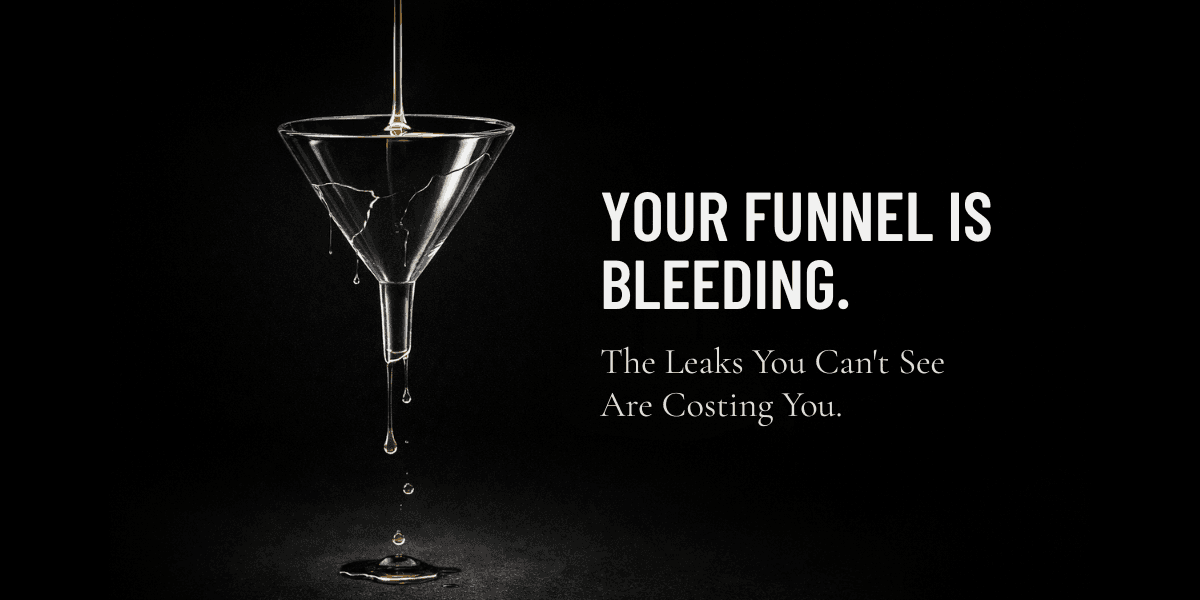

You’re getting traffic. Your landing page looks professional. The design is clean. The copy sounds strong. You even have testimonials.
And yet…Sales feel inconsistent. Scaling feels risky. Ad spend feels heavier than it should.Here’s the uncomfortable truth:Most funnels don’t fail loudly. They fail quietly. They leak.
The 1% vs 8% Reality No One Talks About
Across hundreds of funnel audits, the pattern is consistent:
- Average The average funnel converts at just 1–2%
- Optimized Properly optimized funnels convert at 5–12%
- At 1% → 10 sales
- At 8% → 80 sales
Different architecture.
If you’re spending on ads, that gap isn’t theoretical. It’s paid for every single day.Why 94% of “Professional” Funnels Underperform
After analyzing 300+ funnels across industries, one pattern repeats:
94% of professional-looking funnels fail for the same 3 reasons.
Not because the offer is bad. Not because the niche is wrong. Not because traffic is low.
Because of hidden conversion killers inside the funnel itself.And they almost always fall into 3 categories:
1. Funnel Structure: The Silent Drop-Off Machine
Most founders obsess over copy. Very few audit flow.
Questions to ask:
- Is your buyer journey linear and intentional? Or does it feel like a maze?
- Are there competing CTAs?
- Is checkout frictionless?
- Is mobile actually optimized?
- Do you know where people drop off?
Without proper tracking, you’re guessing. And guessing is expensive. A structural leak doesn’t scream. It quietly kills 30–60% of your potential buyers before they ever reach checkout.
2. Buyer Psychology: Pretty ≠ Persuasive
Most funnels are designed to look good. Very few are engineered to convert.
Common issues:
- Value propositions that sound generic
- Benefits listed without emotional triggers
- No objection pre-handling
- Social proof buried too low
- Authority not established early
High-converting funnels don’t just explain. They sequence belief.
They move a prospect from: Curious → Interested → Convinced → Certain
If your funnel reads like a brochure instead of a guided decision path, conversions stall.
3. Conversion Clarity: Confused Minds Don’t Buy
This one is brutal.Multiple buttons. Multiple paths. Multiple distractions.A confused buyer doesn’t argue. They leave.
The highest-performing funnels almost always share one trait:- One clear path.
- One primary action.
- No friction.
Why You Can’t Spot Your Own Leaks
There’s a reason founders struggle to fix this themselves.You’re too close to your offer.
Without an objective diagnostic lens, optimization turns into random tweaking.Colors change. Headlines change. Button copy changes.
The core leak remains.
The Real Cost of Waiting
If your funnel converts at 1–2% instead of 6–8%, and you’re running ads, you’re paying for traffic you don’t monetize.That’s not a marketing problem. That’s a math problem.
The difference between average and optimized funnels is often worth $1,000–$10,000+ in lost monthly revenue for many businesses.And the longer it runs unfixed, the harder scaling becomes. Because you’re trying to scale a leaking system.More traffic into a broken funnel doesn’t increase profit. It increases waste.The Smarter Move: Diagnose Before You Scale
Instead of:- × Redesigning randomly.
- × Doubling ad spend.
- × Blaming your niche.
- × Rewriting your entire offer.
Start with clarity.
That’s exactly why I built the Funnel Profit Leak Assessment.It’s a 15-question diagnostic designed to evaluate your funnel across the 3 critical profit areas.
In under 3 minutes, you get:
- A Funnel Health Score
- Identification of your top 3 conversion killers
- An estimate of your monthly profit leak
- Clear priority action steps
Just structured clarity.
One Final Question
If someone could increase your conversion rate from 1% to even 5%, would that change your business?- Would it change how confidently you run ads?
- How you launch?
- How you plan revenue?
Because the difference between a “good-looking funnel” and a profitable one… Is usually invisible. Until you measure it.