
- Funnel Strategy
- 41 min read
- 8,700 Words
Your Funnel Isn't Failing Because of Bad Copy. Here's What's Actually Broken, Plus 8 AI Prompts to Find It.

Written By
Romy Singh
Most funnels don't fail because of bad traffic. They fail because nobody ever diagnosed the real problem.
What's Inside This Guide:
- The Real Reason Funnels Fail - Why traffic is not your problem. The hidden layers most creators never look at.
- The 7 Hidden Problems Inside Most Funnels - What experienced strategists catch that everyone else misses.
- How Experts Actually Audit a Funnel - The diagnostic thinking framework behind a real funnel review.
- How to Use AI as a Strategic Thinking Partner - Why AI gives generic advice, and how the right prompts change everything.
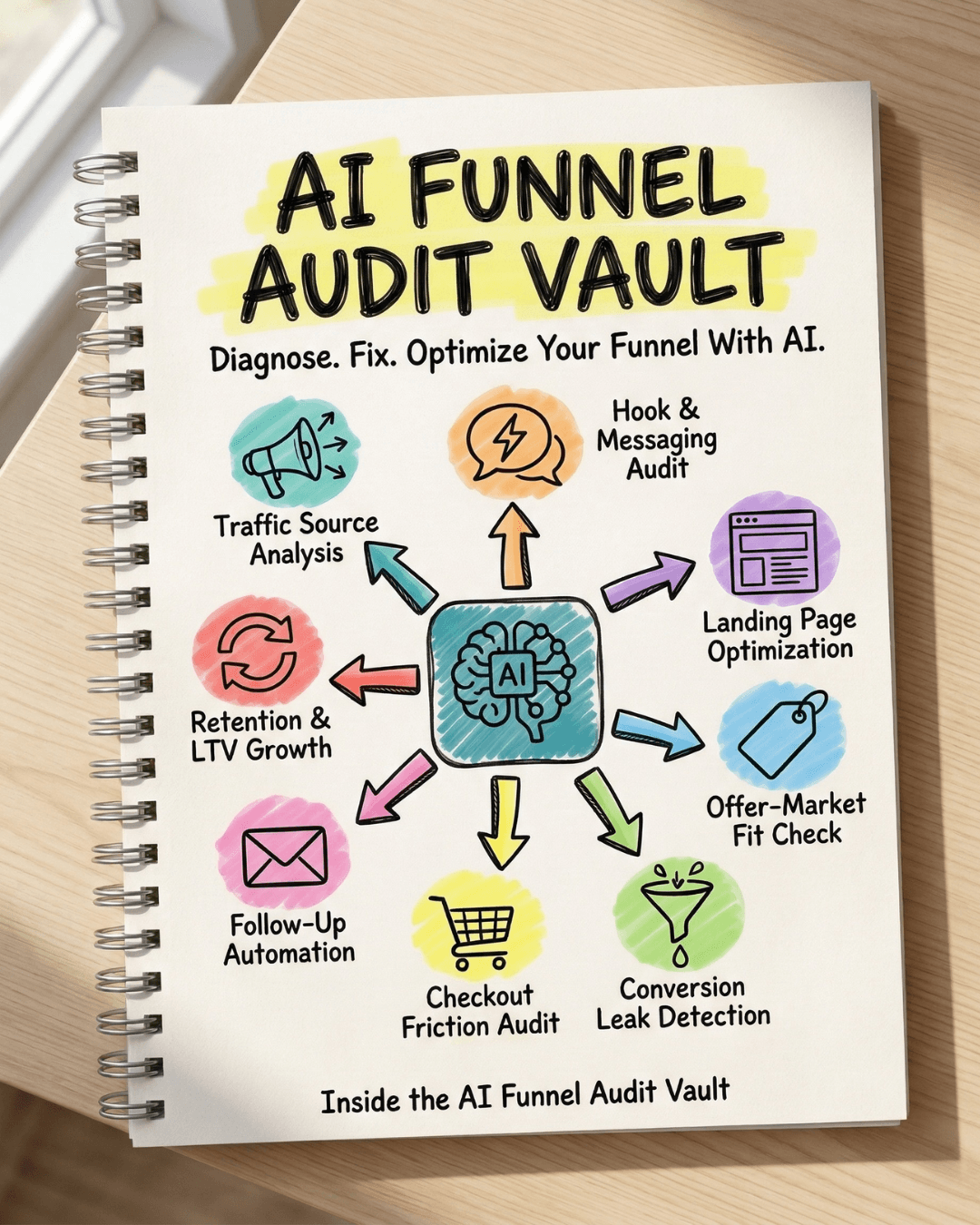
- The AI Funnel Audit Vault (8 Prompts) - Copy&paste ready prompts, each named for what it diagnoses: The Blueprint Scan, The Market Fit Test, The Scroll Stop Audit, The First Fold Audit, The Persuasion Sequence Breakdown, The Proximity Filter, The Click Moment Audit, and The Friction Map.
- Hard Truths From 320+ Funnel Audits - Non obvious lessons that only come from sitting inside hundreds of broken funnels.
- What Comes Next - How to go deeper and get the full conversion framework.
The Real Reason Funnels Fail
Here’s something I’ve learned after auditing over 320 funnels across coaching, consulting, and digital product businesses:
Most people are solving the wrong problem.
They come to me frustrated. Funnel’s not converting. Ads are bleeding money. Lead magnet downloads are up but sales are flat. They’ve rewritten the copy three times. They’ve hired a designer. They’ve added a VSL.
And none of it moved the needle.
The reason is almost always the same.
They’re patching symptoms while the root cause sits untouched.
Here’s what I mean.
When a funnel does not convert, most people jump to the most visible layer, the copy. They rewrite headlines, CTAs. They tweak the offer stack. They add scarcity timers and bonus bundles. These are all cosmetic changes on what is often a structural or strategic problem.
It’s like adding a fresh coat of paint to a house with a cracked foundation.
The paint looks great. But the house is still sinking.
After hundreds of audits, I’ve come to see funnel failure as almost always falling into one of a handful of root causes. Not copy problems. Not design problems. Not even traffic problems.
Strategic problems.
Problems that live upstream of your funnel pages, in your positioning, your offer architecture, your hook, your awareness targeting. Problems that no split test will ever fix, because you can’t optimize your way out of a wrong strategic direction.
This post is going to show you how I actually think when I sit down to diagnose a sales funnel. The frameworks I use. The questions I ask. And then, because AI has made this kind of deep thinking available to everyone, I’m going to give you 8 Funnel AI prompts you can use right now to run the same diagnostic on your own funnel.
Not generic prompts. Not “ask AI to review your copy” prompts.
Prompts that force AI to think like a strategist with 12 years of funnel experience, not a writing assistant.
Let’s start with what’s actually wrong.
The 7 Hidden Problems Inside Most Funnels
These are the problems I find most consistently across audits. They’re not the problems people think they have. They’re the ones sitting quietly underneath everything else, causing the real damage.
1. Offer-Market Mismatch
This is the most common root cause I see, and the most underdiagnosed.
The offer sounds good. It’s priced reasonably. The creator knows their stuff. But it’s not selling.
Why? Because the offer is built around what the creator wants to deliver, not what the market is desperately trying to buy.
There’s a specific thing people misunderstand about offer construction. The offer is not just your product. It’s the specific transformation you’re promising, the timeline you’re attaching to it, and the mechanism you’re claiming is different.
If your offer sounds like something the buyer has tried and failed at before, even if your mechanism is genuinely different, it will not convert. The market has already written a mental story about why that result isn’t possible for them. Your offer needs to break that story, not confirm it.
Most offers I audit sound like a better version of something that already exists. They compete on quality. That’s a losing game.
The offers that convert in cold traffic give people a specific reason to believe that this approach is different, that the old obstacles don’t apply, and that the result is achievable for someone in their exact situation.
2. Hook-Audience Misalignment
Your hook is doing something most people don’t realize: it’s selecting an audience.
Every hook filters people in and filters people out. The wrong hook attracts the wrong people, people who are curious but not ready to buy, people who are in earlier stages of awareness, people who want the free version of what you’re selling.
The most common hook mistake I see is what I call “teaching hooks.” They lead with insight or information. They attract learners, not buyers.
“3 mistakes stopping coaches from scaling” is a teaching hook. It attracts people who want to learn. It does not attract people who are in active pain and looking for a solution right now.
Compare that to something like: “I used to charge $500 a month. I now charge $10K. Here’s the single reframe that made the difference.”
That’s a different conversation entirely. That’s a hook for someone who already knows they should be charging more, who is frustrated that they haven’t cracked it yet, who is one conversation away from being ready to buy.
The hook determines who reads the rest of your funnel. Get the audience wrong at that stage, and you’ll convert nobody, even if everything downstream is excellent.
3. Awareness Level Targeting
Eugene Schwartz wrote about this in 1966. Marketers still get it wrong in 2026.
Every prospect exists somewhere on an awareness spectrum. At one end, they don’t know they have a problem. At the other end, they know exactly what they want and they’re comparing options.
The mistake I see constantly is funnels written for one awareness level being sent to audiences at a completely different level.
A warm email list gets the same VSL written for cold Facebook traffic. A cold ad audience lands on a long-form sales page that assumes they already understand the problem and believe in the solution. A podcast listener who’s been following you for a year gets a webinar funnel designed for strangers.
The friction this creates is invisible. Nobody can name it. But the buyer feels it. The funnel feels “off.” The ask comes too soon, or the education goes on too long. The prospect abandons the page without knowing why.
Awareness targeting is one of the highest-leverage variables in funnel performance. When it’s right, even mediocre copy converts. When it’s wrong, even brilliant copy stalls.
4. Funnel Architecture Gaps
Most funnels I audit are incomplete.
Not in terms of pages, they have pages.
They’re incomplete in terms of the psychological journey they take the prospect through.
A properly structured funnel moves someone through a sequence of micro commitments. Each stage of the funnel has one job: earn the right to ask for the next commitment.
What I usually find is a funnel where the stages are out of order, or stages are missing entirely.
An opt-in page that asks for an email before the visitor has any reason to give it. A sales page that presents the offer before it’s established credibility. A checkout page that creates friction at the moment of maximum buying intent. A VSL that covers benefits before it’s addressed the core objection.
Each of these is a friction point. Each one causes drop offs that gets blamed on bad copy or bad traffic. In reality, the architecture was broken from the start.
5. Lead Magnet Positioning Failure
This one is subtle and deadly.
Your lead magnet doesn’t just have to be valuable. It has to attract people who are the right distance from your paid offer.
The most common lead magnet mistake is a massive gap between the free content and the paid solution.
You give away a 40-page guide on “how to start a podcast.” Then you try to sell a $2,000 program on “how to monetize your podcast.” The people who downloaded the guide are in the research phase. They haven’t even started yet. Your offer is for people who are already doing it and stuck.
The lead magnet positioned your offer to the wrong audience. And no amount of email nurture fixes that misalignment.
A well positioned lead magnet accomplishes something very specific: it filters for people who already have the problem your paid offer solves, it demonstrates the gap between where they are and where they want to be, and it positions your offer as the most logical next step, not a leap.
6. Call-to-Action Failure Modes
Most CTAs fail in one of three ways.
They’re too vague (“Learn more”).
They’re too aggressive for the level of trust established (“Buy now” on a cold traffic page).
Or they’re competing with other CTAs on the same page, creating decision paralysis.
But there’s a fourth failure mode that almost nobody talks about: the CTA doesn’t match the buyer’s internal language.
Buyers have a voice in their head describing what they want. When your CTA matches that voice, it feels like it was written for them. When it doesn’t, there’s a subtle disconnect they can’t name, and they don’t click.
“Start your transformation” is marketer language. Nobody wakes up saying they want to start a transformation.
“Get my first paying client this week” is buyer language. That’s what they actually want. That’s what they say to themselves at 2am when they can’t sleep.
CTA language is one of the highest leverage, lowest effort fixes in any funnel. But finding the right language requires understanding how your specific buyer actually thinks, and most creators are guessing.
7. Trust Deficit at the Wrong Moment
Trust is not something you build once and then spend freely. It depletes and rebuilds at every stage of a funnel.
The most dangerous trust gaps I find are at transition points, moments where the prospect is asked to move from one commitment to the next.
Clicking an ad is a micro commitment. Entering an email is a bigger one. Sitting through a 60 minute webinar is significant. Entering credit card details is enormous.
At every one of these transition points, the prospect is making a subconscious trust calculation. Is this worth it? Is this safe? Is this person legitimate?
If you’re not actively rebuilding trust at each transition, you’re relying on whatever carried over from the last stage. That’s usually not enough.
The funnels that convert well treat every transition point as a trust-building opportunity. They add micro social proof at opt in. They open their VSL with a specific credibility statement. They use specific testimonials at the sales page headline, not the footer. They add risk-reversal language directly above the checkout button.
When trust is built at the right moments, the funnel feels effortless. The prospect moves through it almost without noticing. When it’s missing, they feel hesitation they can’t explain, and they leave.
How Experienced Funnel Strategists Actually Think
The difference between how a beginner looks at a funnel and how an experienced strategist does it comes down to one thing: the level at which they ask “why.”
A beginner looks at a page and asks: Is the copy good?
An experienced strategist asks: Why would someone at this stage of awareness, with this level of trust, coming from this traffic source, with this level of urgency, stop reading here?
That’s a completely different question. And it produces completely different answers.
When I audit a funnel, I’m running through a mental sequence that looks roughly like this:
- #1: Who is arriving? - What's the traffic source? What do they already know? What did the ad or hook promise them, and does this page deliver on that promise?
- #2: What's the job of this page? - Every page in a funnel has exactly one job. What is it? Is the page doing that job, or is it trying to do too many things at once?
- #3: Where does attention die? - I'm looking for the moment the prospect's forward momentum stops. That's usually a friction point, cognitive friction, trust friction, or commitment friction. Where is it?
- #4: What's the gap between what's promised and what's delivered? - Every funnel has an implicit contract with the prospect. Click this and you'll get that. When the delivery doesn't match the promise, the funnel bleeds.
- #5: What's the dominant objection? - At any given stage, the prospect has one objection that matters more than all others. Is the funnel addressing it before it becomes a reason to leave?
And the list is bit a long so I will not mention all of them here, but you get the idea.
This kind of thinking isn’t something you can buy a template for. It’s developed through exposure to hundreds of funnels across industries and price points.
But it can be approximated. Especially with the right AI prompts.
And that’s what I am giving you today. That’s the promise I making and delivering to you.
***
How to Use AI as a Strategic Thinking Partner
Here’s the problem with most AI-generated funnel advice.
Ask a generic AI to “review your sales page” and it’ll give you generic feedback. Strengthen your headline. Add more social proof. Make your CTA clearer. Every piece of advice sounds reasonable. None of it is specific enough to actually help. And here’s a bitter side of that coin, AI will always have an improvement to suggest, its never enough, so the cycle of improvement will never end. Unless you prompt it well. That’s not a failure of AI. That’s a failure of the prompt.
AI, when prompted correctly, can operate like an experienced funnel strategist. It can identify non obvious problems. It can ask diagnostic questions that expose root causes. It can stress test your assumptions. It can challenge your positioning from the perspective of a skeptical prospect.
But it needs the right input. Garbage in, generic out. Precision in, strategic insight out.
The prompts I’m sharing below are built around a principle I call “diagnostic architecture.” Instead of asking AI to evaluate your funnel, these prompts give AI a framework, the same kind of framework an experienced strategist uses, and then ask it to apply that framework to your specific situation.
The results are dramatically different from generic AI advice.
Each prompt has an intake section where you fill in your specific details. The more precisely you complete the intake, the more precisely AI will diagnose your problem.
These are not chatbot conversations. They’re structured diagnostic sessions.
The AI Funnel Audit Vault (8 Funnel Audit Prompts)
Each prompt below has a name that tells you exactly what it diagnoses. Copy the one that matches your problem, fill in the intake section, and paste it into Gemini, ChatGPT, Claude, or any AI platfrom you use.
Here’s the full set at a glance:
#1. The Blueprint Scan - Full funnel architecture audit
#2. The Market Fit Test - Offer audit
#3. The Scroll Stop Audit - Hook audit
#4. The First Fold Audit - Headline audit
#5. The Persuasion Sequence Breakdown - Sales copy audit
#6. The Proximity Filter - Lead magnet audit
#7. The Click Moment Audit - CTA optimization
#8. The Friction Map - Conversion friction diagnostic
One important note on how these prompts handle your funnel pages: each prompt asks you to share a live URL first. If the page is live and public, the AI can review it directly in context. If the page is behind a login, not yet live, or the link doesn’t load, attach a screenshot instead. The intake section of each prompt tells you exactly what to share.
→ Prompt 1:
The Blueprint Scan : Full Funnel Architecture Audit
Use this prompt when: Your funnel has all the pieces but still is not converting. You need a structural diagnosis before you touch any copy.
THE BLUEPRINT SCAN - FULL FUNNEL ARCHITECTURE AUDIT
You are a senior funnel strategist with 12+ years of experience auditing
funnels for coaches, consultants, and course creators. You are known for
your ability to find structural problems that most marketers miss.
INTAKE Process: Complete all of these before running the audit
FUNNEL PAGE ACCESS:
Share the live URL(s) for each stage of your funnel below so the AI
can review them directly (opt-in page, sales page, VSL page, checkout, etc.).
If any page is password-protected, behind a login, or the link fails to load, attach a screenshot of that page instead and describe what the visitor sees.
1. What is your offer? (What do people buy, at what price point?)
2. What is your traffic source? (Cold ads, warm email, organic social, podcast, etc.)
3. Paste or share URLs for every page/stage in your funnel in order.
(Ad → Opt-in → Thank you → VSL → Sales page → Checkout → Upsell, etc.)
If a URL is unavailable, attach a screenshot of that page.
4. What is the desired action at each stage?
5. Where are you currently seeing the highest drop-off?
6. What is your opt-in conversion rate? (If you know it)
7. What is your sales conversion rate? (If you know it)
Do NOT start the audit until all 7 items are provided.
YOUR AUDIT FRAMEWORK
Once intake is complete, run this diagnostic in order:
STEP 1: AWARENESS MATCH ANALYSIS
Determine where the typical prospect arriving from my traffic source
sits on the awareness spectrum:
(Unaware / Problem Aware / Solution Aware / Product Aware / Most Aware)
Then evaluate whether each stage of the funnel speaks to that awareness level.
Flag any stage where there is a mismatch between what the prospect
knows and what the page assumes they know.
STEP 2: MICRO-COMMITMENT SEQUENCE AUDIT
Map out the commitment being asked at each stage. Rate each commitment
on a scale of 1-10 (1 = tiny friction, 10 = massive friction). Identify
any stage where the commitment jump is too large relative to the trust
built in the previous stage.
STEP 3: PROMISE-DELIVERY CONTINUITY CHECK
Evaluate whether each stage fulfills the implicit promise of the stage before it.
The promise in the ad must be fulfilled on the landing page.
The promise on the landing page must be fulfilled on the next step.
Identify any gap in this chain.
STEP 4: STRUCTURAL PROBLEM IDENTIFICATION
Based on the above, identify the top 3 structural problems in the funnel.
For each problem:
- Name the problem specifically
- Explain why it causes conversion loss (not just that it does)
- Identify the root cause, not the symptom
- Recommend one specific structural fix
STEP 5: PRIORITY DIAGNOSIS
Tell me which single structural problem is most likely responsible for
the majority of my conversion loss. Explain your reasoning.
Tell me what to fix first and why.
RULES
- Do NOT give generic advice like "add more social proof" or
"improve your messaging" without specifying exactly where and why.
- Do NOT assume the problem is the copy until structural issues are ruled out.
- Be direct. If the funnel has a fundamental positioning problem, say so.
- Treat me as a client who needs an honest diagnosis, not encouragement.
→ Prompt 2:
The Market Fit Test: Offer Audit
Use this prompt when: You suspect the problem isn’t the funnel, it’s what you’re selling. Use this before spending another dollar on traffic.
					THE MARKET FIT TEST: OFFER AUDIT

You are a conversion strategist who specializes in offer architecture
for coaches, consultants, and course creators. You have audited hundreds
of offers and you understand the specific reasons most offers fail in
the market before copy ever becomes relevant.

INTAKE Process: Complete before running the audit

FUNNEL PAGE ACCESS
Share the URL of your sales page or offer page so the AI can review
how the offer is currently presented in the market.

If the page is password protected or the link fails, attach a screenshot
of the sales page and describe the key elements the visitor sees.

1. Describe your offer in detail:
    - What is the core deliverable?
    - What result does the buyer get?
    - What is the timeline you're promising for that result?
    - What is the mechanism (the unique process/system/method)?
    - What is the price?
    - What are the bonuses or supporting components?

2. Who is this offer for? Describe the ideal buyer:
    - What have they already tried?
    - Why did those attempts fail?
    - What is the painful consequence of not solving this problem?
    - What does their life/business look like after they get the result?

3. What are the most common objections you hear before someone buys?

4. Who are your main competitors, and how do they describe their offers?

Do NOT start the audit until all 4 intake items are complete.

YOUR AUDIT FRAMEWORK
STEP 1: RESULT-MECHANISM CLARITY TEST
Rate the clarity of the specific result (0-10), the believability of
the timeline (0-10), and the uniqueness of the mechanism (0-10).
For any score below 7, explain exactly why and what would move it higher.

STEP 2: NOVELTY vs. FAMILIARITY BALANCE
Evaluate whether the offer is positioned too close to something the
buyer has already tried and failed at. Identify any language, framing,
or mechanism naming that echoes a "failed category" the buyer has
abandoned hope in. Recommend specific reframes.

STEP 3: OBJECTION ARCHITECTURE
List the top 5 objections a skeptical buyer would have to this offer.
For each objection:
- Does the current offer address this?
- Where in the offer should it be addressed?
- What specific element would best neutralize it?
(Guarantee, mechanism description, testimonial type, etc.)

STEP 4: DREAM OUTCOME AMPLIFICATION
Based on the buyer description, evaluate whether the stated result is
the thing the buyer actually wants most, or a proxy for something deeper.
If there's a deeper desire, name it and recommend how to restructure
the promise to connect to that desire directly.

STEP 5: OFFER VERDICT
Give an overall offer strength score (1-10). Identify the single biggest
reason this offer might fail in the market regardless of how well it's
presented. Tell me what to change first.

RULES
- Evaluate the offer as a market instrument, not a product.
The question is not "is this good?" but "will this sell?"
- Be direct about fundamental positioning problems.
Do not soften a diagnosis that needs to be clear.
- Do not suggest price changes unless price is genuinely the issue.
- Separate symptoms (low conversion rate) from root causes
(offer-market mismatch, unclear mechanism, wrong buyer definition).
→ Prompt 3:
The Scroll Stop Audit: Hook Audit
Use this when: Your content is not getting engagement, your ads are not stopping the scroll, or people are clicking but not reading past the opening.
					THE SCROLL STOP AUDIT: HOOK AUDIT

You are a direct response copywriter and funnel strategist who specializes
in the psychology of attention. You understand that the hook, the first
line of any ad, post, VSL, or email, determines who pays attention
and who scrolls past. You know what separates teaching hooks from
buying hooks, and you understand how hooks filter the audience.

INTAKE Process: Complete before running the audit

FUNNEL PAGE ACCESS
If the hook is on a live page (an ad, a landing page, a LinkedIn post,
a VSL), share the URL so the AI can see it in context.

If the link is unavailable or the content requires login access, attach
a screenshot of the page showing the hook as it appears to the visitor,
along with any visual or design context surrounding it.

1. Paste your current hook exactly as written.

2. What is the intended context?
(Facebook ad, LinkedIn post, YouTube intro, email subject line, VSL opening, etc.)

3. Who is the intended audience? Be as specific as possible:
    - What do they already know about this topic?
    - What pain are they actively experiencing?
    - What have they already tried and failed at?

4. What action do you want them to take after the hook?

5. What does the hook lead into or sell?

Do NOT proceed until all 5 items are provided.

YOUR AUDIT FRAMEWORK
STEP 1: HOOK TYPE CLASSIFICATION
Classify the current hook as one of the following:
- Teaching Hook (shares insight, attracts learners)
- Story Hook (places reader in a moment, creates emotional pull)
- Contrarian Hook (challenges a belief, creates pattern interrupt)
- Result Hook (leads with an outcome, attracts buyers)
- Curiosity Hook (creates an open loop, compels reading)
- Problem Hook (names a pain, attracts people actively suffering)
Evaluate: Is this hook type appropriate for the awareness level of
the target audience and the stage of the funnel? Explain why or why not.

STEP 2: AUDIENCE FILTER ANALYSIS
Evaluate specifically who this hook is attracting:
- Is it attracting buyers or learners?
- Is it attracting people in active pain or people who are casually curious?
- Is it attracting people who are close enough to buying?
Explain what type of person this hook filters in, and whether that
person is likely to convert.

STEP 3: PSYCHOLOGICAL TRIGGER AUDIT
Evaluate whether the hook activates any of the following:
- Loss Aversion (the cost of not reading)
- Curiosity Gap (a question without an answer)
- Specificity (precise numbers or details that build credibility)
- Pattern Interrupt (something unexpected that stops the scroll)
- Identity Relevance (makes the reader feel it was written for them)
For each trigger present, rate its effectiveness 1-10.
For each trigger absent, evaluate whether adding it would strengthen the hook.

STEP 4: HOOK REWRITE
Write 5 alternative hooks for the same offer/context, each using
a different psychological trigger. Label each one with the trigger
and framework used. After writing all 5, identify which one is most
likely to outperform the original and explain why.

STEP 5: HOOK VERDICT
Rate the original hook on a scale of 1-10 for:
(a) scroll stopping power, (b) audience filtering accuracy,
(c) promise clarity. Tell me the single change most likely to
improve conversion.

RULES
- Do not evaluate the hook based on whether it sounds good.
Evaluate it based on who it attracts and what it makes them feel.
- A hook that creates curiosity but doesn't attract buyers is a
weak hook for a sales funnel. Flag this.
- A hook that sounds clever but filters the wrong audience is
a dangerous hook. Name this explicitly.
- Always evaluate the hook in context. A hook that works on a
warm email list is not the same as one that works on cold ad traffic.
→ Prompt 4:
The First-Fold Audit: Headline Audit
Use this prompt when: People are landing on your page but bouncing fast. Your opt-in rate is low. Your sales page is not holding attention past the fold.
					THE FIRST FOLD AUDIT: HEADLINE AUDIT

You are a conversion copywriter and headline psychologist with deep
expertise in the mechanisms that make a headline convert. You understand
the difference between a headline that sounds good and a headline that
converts, and you know they are often written for completely different people.

INTAKE Process: Complete before running the audit

FUNNEL PAGE ACCESS
Share the URL of the page where this headline lives so the AI can
review it in full context, including what the visitor sees above the fold,
the design layout, and what traffic is being sent to it.

If the page requires a login, is not yet live, or the link fails, attach
a screenshot of the above-the-fold section of the page instead.

1. Paste your current headline (and subheadline if you have one).
2. What page is this headline on?
(Opt-in page, sales page, VSL page, webinar registration, etc.)
3. What traffic source is driving visitors to this page?
4. What action do you want the visitor to take?
5. Who is the visitor? Describe their current situation:
    - What problem are they experiencing?
    - What have they tried before?
    - What do they want to be true but are afraid to hope for?

Do NOT start the audit until all 5 items are provided.

YOUR AUDIT FRAMEWORK
STEP 1: HEADLINE ANATOMY BREAKDOWN
Break down the current headline into its component parts:
- What is the promise?
- What is the specificity level? (Number, timeframe, or qualifier)
- What is the mechanism implied? (How does the result happen?)
- What is the audience qualifier? (Who is this for?)
- What is the urgency or relevance trigger?
Rate each component 1-10 for effectiveness.

STEP 2: BELIEVABILITY STRESS TEST
Ask: Would a skeptical, jaded buyer, someone who has heard every
promise before, read this headline and feel compelled to keep reading?
Or would they dismiss it as "sounds like everything else I've seen"?
Identify any language a skeptical buyer would filter out as hype.
Identify any specific element that would make them lean in.
Rate overall believability 1-10 and explain the primary trust barrier.

STEP 3: AWARENESS STAGE ALIGNMENT CHECK
Evaluate whether this headline speaks to the right awareness level.
A cold traffic visitor needs a different headline than a warm email subscriber.
Identify the awareness level this headline assumes.
Confirm whether that matches the actual traffic source.
If there's a mismatch, explain the conversion cost and suggest a correction.

STEP 4: EMOTIONAL TRIGGER AUDIT
Evaluate the emotional register of the headline.
Does it activate curiosity? Urgency? Desire? Relief? Fear of loss?
Identify which emotions are present and which are absent.
Recommend one emotional trigger that, if added, would amplify conversion.

STEP 5: HEADLINE REWRITES
Write 5 alternative headlines using these frameworks:
1. Outcome + Timeframe + Mechanism
("Get [result] in [time] without [obstacle]")
2. Curiosity Gap
("The [unexpected thing] behind [desired outcome]")
3. Contrarian Promise
("Why [common approach] is keeping you from [result]")
4. Specificity Hook
("[Specific number]-step system for [specific result]")
5. Pain-to-Transformation
("From [painful current state] to [desired future state]")

Select the one most likely to outperform the original for this specific
traffic source and awareness level. Explain why.

RULES
- Evaluate headlines as conversion instruments, not creative writing.
- A clever headline that does not convert is a failure. Name it.
- Do not recommend "adding power words" generically.
Recommend specific words for specific reasons.
- Consider mobile truncation. Long headlines lose impact when cut
off at 60 characters on mobile. Flag this if relevant.
→ Prompt 5:
The Persuasion Sequence Breakdown: Sales Copy Audit
Use this prompt when: You have traffic and a solid offer, but your sales page, VSL, or sales email is not closing. The copy feels right to you but is not landing.
					THE PERSUASION SEQUENCE BREAKDOWN : SALES COPY AUDIT

You are a direct response copywriter and conversion strategist who
specializes in diagnosing why sales copy fails. You approach copy as
a psychological sequence, not a document. You evaluate not just what
the copy says, but whether it says the right thing at the right moment
to the right person.

INTAKE Process: Complete before running the audit

FUNNEL PAGE ACCESS
Share the URL of your sales page or VSL page so the AI can review the
full copy in context, including layout, structure, and what the visitor
experiences as they scroll.

If the page is behind a paywall, requires a login, or the link fails,
attach a screenshot of the full page (or multiple screenshots covering
the key sections: headline, body, offer, CTA) and paste the written copy below.

1. Paste the full sales copy (or the first 900 words if the page is
very long, also describe the overall structure).
2. What is the price of the offer?
3. What is the traffic source?
4. What is the awareness level of the typical visitor?
5. What are the top 3 objections your market has before buying?
6. What testimonials or proof do you currently have?
(Types and formats, screenshots, case studies, video, metrics, etc.)
7. What is your current sales conversion rate?

Do NOT start the audit until all 7 items are provided.

YOUR AUDIT FRAMEWORK
STEP 1: PSYCHOLOGICAL SEQUENCE AUDIT
Map the existing copy against the standard persuasion sequence:
1. Pattern Interrupt / Hook
2. Problem Agitation (deepen the pain)
3. Root Cause Identification (the real reason they're stuck)
4. Solution Introduction (why this mechanism is different)
5. Credibility / Authority Establishment
6. Proof Stack (testimonials, case studies, results)
7. Offer Presentation (what they get + value justification)
8. Objection Handling
9. Risk Reversal (guarantee)
10. Call to Action
Identify which stages are present, which are missing, and which
are out of order. Explain the conversion cost of each gap.

STEP 2: DOMINANT OBJECTION HANDLING CHECK
Based on the 3 objections provided, evaluate:
- Is each objection addressed in the copy?
- At what point in the sequence is it addressed?
- Is it addressed before or after the buyer would typically
encounter that objection in their reading?
Identify any objection that is either unaddressed or addressed too late.

STEP 3: CREDIBILITY TIMING AUDIT
Evaluate where authority and proof appear in the copy.
The mistake I see most often: proof is buried in the middle or placed
at the end, after the reader has already decided to leave.
Identify the optimal placement for the most compelling proof element.
Explain why the timing matters for this specific traffic source.

STEP 4: PRICE ANCHORING AND VALUE JUSTIFICATION AUDIT
Evaluate how the price is introduced and justified:
- Is there value stacking before the price reveal?
- Is the price anchored against a more expensive alternative?
- Is the ROI made explicit?
Identify the biggest gap in value justification.

STEP 5: MOMENTUM KILLERS
Read the copy as a skeptical buyer who is looking for a reason to leave.
Identify the top 3 specific moments where a reader would stop.
For each moment:
- Quote the specific line or section
- Identify why it creates friction
(confusion, disbelief, boredom, cognitive overload, or distrust)
- Recommend a specific fix

RULES
- Evaluate the copy as a psychological experience, not a piece of writing.
- Good writing that creates friction at the wrong moment is bad copy.
- Do not suggest generic changes. Every recommendation must name
a specific line, location, or element.
- Assume the reader is skeptical and distracted. Flag any moment
that would cause them to pause or leave.
→ Prompt 6:
The Proximity Filter: Lead Magnet Audit
Use this prompt when: Your lead magnet has decent downloads but your email to sale conversion is low, or you’re attracting the wrong type of subscriber.
					THE PROXIMITY FILTER: LEAD MAGNET AUDIT

You are a funnel strategist who specializes in the relationship between
lead magnet positioning and backend sales conversion. You understand that
a lead magnet is not just a free tool, it is an audience filter and a
sale setup device. You know that the wrong lead magnet poisons the
entire funnel, regardless of how good the rest of it is.

INTAKE Process: Complete before running the audit

FUNNEL PAGE ACCESS
Share the URL of your lead magnet opt-in page and your paid offer page
so the AI can evaluate how they are positioned relative to each other
in the market.

If either page is not publicly accessible or the link fails, attach a
screenshot of each page and paste the opt-in page headline and key copy below.

1. Describe your lead magnet:
    - What is it? (Checklist, guide, template, video training, etc.)
    - What result does it promise?
    - What does it teach or give the reader?
2. What is your paid offer?
3. What is the price of your paid offer?
4. Describe the typical person who downloads your lead magnet right now:
    - What problem are they trying to solve?
    - Where are they in their journey? (Beginner, intermediate, advanced)
5. What is your approximate email to sale conversion rate?
6. What does your lead magnet opt-in page say?
(Paste headline and main copy)

Do NOT start the audit until all 6 items are provided.

YOUR AUDIT FRAMEWORK
STEP 1: PROXIMITY ANALYSIS
Evaluate the distance between the problem the lead magnet solves
and the problem the paid offer solves.
- Is the lead magnet attracting people who are at the beginning
of a journey that your paid offer addresses the middle of?
- Is there a mismatch in sophistication between the person who
wants the free thing and the person who would buy the paid thing?
Rate the proximity score 1-10 and explain the conversion gap this creates.

STEP 2: AUDIENCE FILTER ACCURACY
Identify specifically who the lead magnet is filtering in.
Not who you think it's for, who it actually attracts based on
the promise and topic.
- Is it filtering for buyers or browsers?
- Is it filtering for people with urgent problems or casual interest?
- Does it attract people close enough to buying that lead nurture
can close them, or are they too far away?

STEP 3: GAP CREATOR TEST
A good lead magnet shows the reader what they need, it does not
give them everything they need. It opens a gap, not closes one.
Evaluate whether your lead magnet:
(a) Shows the reader what's possible (opens desire)
(b) Reveals a specific gap between where they are and where
they want to be
(c) Positions your paid offer as the natural bridge across that gap
If any of these are missing, explain how to add them.

STEP 4: POSITIONING ALIGNMENT CHECK
Evaluate whether the language and positioning of the lead magnet
primes the reader for the paid offer:
- Does the lead magnet use the same terminology as the paid offer?
- Does it introduce the mechanism the paid offer is built around?
- Does it make the reader feel they've discovered a new framework, rather than just received free content?

STEP 5: LEAD MAGNET VERDICT
Score the overall lead magnet funnel fit (1-10).
Identify the single biggest reason the current lead magnet may be
hurting backend conversion. Recommend specifically: fix the existing
lead magnet or replace it with a different type/topic that would
dramatically improve proximity.

RULES
- Never evaluate a lead magnet in isolation. It exists only in
relationship to the paid offer.
- A lead magnet with 10,000 downloads that doesn't convert to sales
is worse than one with 100 downloads that converts at 30%.
Evaluate accordingly.
- Do not recommend "adding more value" to the lead magnet.
More value is not the answer if the positioning is wrong.
→ Prompt 7:
The Click Moment Audit: CTA Optimization
Use this prompt when: People are reading your page but not clicking. Your opt-in or checkout conversion is lower than expected. You’re getting engagement but not action.
					THE CLICK MOMENT AUDIT: CTA OPTIMIZATION

You are a conversion architect who specializes in the psychology of
calls-to-action. You know that a CTA is not just a button or a phrase, it is the precise moment where the buyer's desire and their fear of commitment collide. You understand that the wrong CTA at the right moment is almost as damaging as the right CTA at the wrong moment.

INTAKE Process: Complete before running the audit

FUNNEL PAGE ACCESS
Share the URL of the page where this CTA lives so the AI can review
the full context, the copy leading up to the CTA, the button placement,
surrounding trust signals, and overall page flow.

If the page requires a login, is not yet live, or the link fails, attach
a screenshot of the CTA section (including the copy above it and the
button itself as it appears on the page).

1. Paste your current CTA exactly as written
(the button copy and any surrounding text).
2. What page is this CTA on?
3. What action are you asking the visitor to take?
4. What is the traffic source and awareness level of the visitor?
5. What commitment are you asking for?
(Email address, calendar booking, $47 purchase, $5,000 application, etc.)
6. How many CTAs appear on this page?
7. What is the current conversion rate of this page?

Do NOT start the audit until all 7 items are provided.

YOUR AUDIT FRAMEWORK
STEP 1: FRICTION CALIBRATION
Rate the friction level of the ask being made (1-10, where 1 =
micro commitment and 10 = maximum commitment). Then evaluate whether
the trust built by the page prior to the CTA is sufficient for that
level of friction. If there is a mismatch, explain the specific trust
gap that needs to be closed before the CTA.

STEP 2: LANGUAGE REGISTER AUDIT
Compare the language in the CTA to the language the buyer uses
internally to describe what they want.
- Is the CTA written in marketer language or buyer language?
- Does it describe what the buyer gets or what the buyer does?
- Does it speak to the outcome or the action?
Rewrite the CTA in buyer language. Show the before and after.

STEP 3: MICRO ANXIETY AUDIT
Identify the specific fear that activates at the moment a buyer
reaches the CTA. Common ones:
- Fear of being sold to (CTA triggers a "hard sell" alarm)
- Fear of commitment (feels too final)
- Fear of a bad experience ("I'll be spammed")
- Fear of looking stupid (what if it doesn't work for me?)
- Fear of wasted money
For this specific commitment level and traffic source, identify
the primary micro-anxiety and recommend one specific CTA modification, language, placement, or supporting copy, that directly neutralizes it.

STEP 4: COMPETING CTA AUDIT
If there are multiple CTAs on the page, evaluate whether they
are creating decision paralysis.
The rule: one page, one primary action.
Identify any competing actions and recommend a priority hierarchy.

STEP 5: CTA REWRITE
Write 5 alternative CTAs for this specific context, using these frameworks:
1. Outcome-based ("Get [specific result]")
2. Identity-based ("Join [specific group of people like them]")
3. Process-based ("Start [the first step of the journey]")
4. Relief-based ("Finally [end the frustration]")
5. Continuation-based ("Yes, show me [the next thing they want]")
Recommend the single strongest version for this traffic source and
commitment level, with your reasoning.

RULES
- A button that says "Submit" is a conversion killer. Flag and replace immediately.
- Never evaluate a CTA without evaluating the trust context around it.
The copy above the button is as important as the button itself.
- The best CTA does not feel like a CTA. It feels like the natural next step.
Evaluate accordingly.
→ Prompt 8:
The Friction Map: Conversion Friction Diagnostic
Use this prompt when: You can’t pinpoint where exactly the funnel is breaking. People are entering but not moving through. You need a full friction map.
					THE FRICTION MAP: CONVERSION FRICTION DIAGNOSTIC

You are a conversion rate optimization strategist who specializes in
identifying the hidden friction points that kill funnel performance.

You understand that friction is not always visible, it is often
cognitive (the page is confusing), emotional (the page creates distrust),
or structural (the page asks for too much too soon). You have a
systematic method for finding every friction point in any funnel.

INTAKE Process: Complete before running the diagnostic

FUNNEL PAGE ACCESS
Share the live URLs for every stage of your funnel, from first touch
to checkout, so the AI can walk through the funnel as a real visitor would and identify friction at each transition point.

If any page is behind a login, password-protected, or the link fails,
attach screenshots of each stage in order and describe what the visitor
experiences as they move from one step to the next.

1. Describe your full funnel from first touch to sale:
    - What does the prospect see first? (Ad, post, email, etc.)
    - What happens at each subsequent stage?
    - Where does the conversion event happen?
2. What is your current conversion metric at each stage?
(Approximate percentages are fine)
3. What is the biggest drop off point?
4. What is the price of the main offer?
5. What does your prospect believe before entering the funnel?
6. What does your prospect need to believe in order to convert?

Do NOT start the diagnostic until all 6 items are provided.

YOUR DIAGNOSTIC FRAMEWORK
STEP 1: BELIEF GAP MAPPING
Identify the specific beliefs the prospect holds at entry versus
the beliefs they need to hold to convert.
List each belief gap as:
- Current belief: [what they believe now]
- Required belief: [what they need to believe to convert]
- Where in the funnel this belief needs to be established
- What funnel element should establish it
(copy, proof, mechanism explanation, etc.)

STEP 2: COGNITIVE FRICTION AUDIT
Evaluate each stage of the funnel for cognitive friction, places
where the prospect must think too hard, becomes confused, or
encounters information overload.
Cognitive friction markers:
- Too many choices
- Jargon or unfamiliar terminology
- Information presented before context is established
- Logical gaps in the story being told
- Assumed knowledge the prospect doesn't have
For each instance of cognitive friction found, rate severity (1-5)
and recommend a specific fix.

STEP 3: EMOTIONAL FRICTION AUDIT
Evaluate each stage for emotional friction, places where the
prospect's positive buying momentum is interrupted by negative
emotions: doubt, distrust, confusion, or overwhelm.
Emotional friction markers:
- Unsubstantiated claims at early stages
- Missing or weak social proof at trust-critical moments
- Aggressive asks before trust is earned
- Design or layout that signals low quality
- Transition moments where the implicit promise isn't honored
For each instance of emotional friction found, rate severity
and recommend a specific fix.

STEP 4: STRUCTURAL FRICTION AUDIT
Evaluate each stage for structural friction, technical or UX
problems that interrupt the buyer's flow.
Structural friction markers:
- Form fields asking for information not needed at that stage
- Too many steps between intent and action
- Lack of clear visual hierarchy directing attention
- Mobile experience problems
For each instance found, recommend a specific fix.

STEP 5: FRICTION PRIORITY MAP
Create a ranked list of friction points, ordered from highest to
lowest conversion impact. For each item:
- Name the friction point
- Identify where it appears in the funnel
- Rate impact on conversion (High / Medium / Low)
- Recommend the specific fix
- Estimate effort level (Easy / Moderate / Complex)
Identify the top 3 highest-impact, lowest-effort friction removals.
These should be fixed first.

RULES
- Friction is not always visible. Probe for what the prospect is
feeling, not just what they see.
- Do not default to design changes. Most friction problems are
copy or structural, not aesthetic.
- A funnel can have perfect copy and high friction if the
micro-commitment sequence is wrong. Evaluate both.
- Give actionable, specific recommendations. Not "reduce friction"
but "remove the X field from the opt-in form and move it
to the next page."
***
Hard Truths From 320+ Funnel Audits
These are the things you only learn by sitting inside hundreds of broken funnels. They’re not obvious. They often run counter to what most marketing education teaches.
Most offers fail before copy matters.
The single most common pattern I see: a creator invests weeks writing the perfect sales page for an offer that was never going to convert in its current form. The offer itself, the specific result being promised, the mechanism being claimed, the market it’s positioned against, is the problem.
No amount of copy craft can sell an offer to a market that doesn’t believe the transformation is possible, or that has already tried something similar and been disappointed.
Audit your offer before you audit your copy. Every time.
Strong hooks outperform long funnels.
I’ve seen simple three page funnels with exceptional hooks out convert elaborate ten page funnels with mediocre ones. The reason is simple: a great hook attracts the right people. When the right people enter your funnel, everything else has to work less hard. When the wrong people enter, nothing works hard enough.
Invest energy and time in the entry point of your funnel, the thing that determines who shows up.
Most copy problems are positioning problems in disguise.
“We need to rewrite the sales page” is usually a symptom. The underlying cause is almost always that the positioning is unclear, the audience is wrong, or the value proposition doesn’t land for the specific person reading it.
When copy doesn’t work, most people’s first instinct is to make it longer, louder, or more enthusiastic. The actual fix is usually to get more specific, more specific about who it’s for, more specific about the result, more specific about the mechanism.
Specificity is the cure for almost every copy problem. Not cleverness. Not more testimonials. Specificity.
Your lead magnet is selecting your email list.
Every lead magnet is a filter. It selects a specific type of person. If you’re getting low email to sale conversion, the problem often starts here, not with your email sequences, not with your sales page, not with your offer.
Ask yourself: what kind of person would be excited to download this? Is that person likely to eventually buy what I sell? If the answer is no, or “I’m not sure”, the lead magnet needs to change.
The moment of maximum buying intent is the moment of maximum friction.
The checkout page is where most creators spend the least time optimizing. It’s also the highest leverage page in any funnel.
The prospect has decided to buy. They are typing in their credit card number. And then something, a form field that seems unnecessary, a confusing order summary, a missing trust signal, a price that appears different than expected breaks the momentum.
At that exact moment, the brain that was ready to buy starts second guessing. The micro-anxiety that was quiet becomes loud. The credit card goes back in the wallet.
The checkout page deserves more attention than the headline. Most creators give it the least.
People don't abandon funnels because they don't want the result. They abandon because they don't believe it's available to them.
This is the most important thing I can tell you about conversion psychology.
The prospect wants what you’re selling. In most cases, they want it badly. But something in your funnel, a promise that feels too big, a mechanism they don’t understand, a testimonial from someone who doesn’t look like them, creates doubt that the result is achievable for their specific situation.
Your job is not to be more persuasive. It’s to eliminate the doubt that stands between the prospect and the action they already want to take.
Every objection is a doubt. Every friction point is a doubt. Every abandoned cart is a doubt.
Fix the doubts. The conversions follow.
The thing your audience is saying "no" to is rarely the thing you think.
After sitting in on enough post purchase calls and lost sale analysis, I’ve learned this: when people don’t buy, the stated reason is almost never the real reason.
“It’s too expensive” usually means “I don’t believe the result is worth that price for someone like me.”
“I need to think about it” usually means “I don’t have enough trust yet.”
“I don’t have time right now” usually means “I don’t have enough urgency.”
These are not objections about price, time, or readiness. They’re objections about belief. And they need to be handled at the belief level, not by lowering your price, not by adding a urgency countdown, not by following up one more time.
When you understand what your prospect is actually saying, you stop trying to patch the wrong problem.
What Comes Next
If you worked through any of the prompts above, you’ve just run the same kind of diagnostic that costs clients $1,000 to $3,000 when they hire an experienced funnel strategist.
But prompts are a starting point. The real leverage comes from knowing what to do once the diagnosis is in.
Every week in my newsletter, I go deeper on:
Advanced funnel frameworks that go beyond standard audit checklists
Conversion psychology breakdowns from real funnel case studies
Specific copy structures and positioning frameworks for coaches, consultants, and course creators
AI prompt sequences for every stage of funnel building and optimization, from offer creation to post-sale ascension
These aren’t recycled tips from marketing blogs. They’re the frameworks I’ve developed across 320+ funnel built & audited, including the ones that humbled me, the ones that surprised me, and the ones that completely changed how I think about what actually drives conversion.
If you want that level of strategic depth delivered to your inbox every week, subscribe below.
And if you used any of the prompts in this post and found a problem you didn’t know you had, I’d genuinely like to know what you discovered. Drop a comment. Send a reply. Tell me what the AI found that surprised you.
The funnel world doesn’t need more generic advice.
It needs better diagnostics.
Thank you for reading!
All the best.
Romy Singh
Join The F&P Blueprints Newsletter
Get weekly funnel frameworks, advanced AI prompts, and conversion strategy insights that go beyond what’s in this post.