
- Funnel Strategy
- 45 min read
- 11,500 Words
You're Not Charging Too Much. You're Framing It Wrong. (The Pricing Psychology Vault)

Written By
Romy Singh
The number isn't killing your conversions. The context around the number is.
🔒 Subscriber-only post | 11,500 words | 45-min read | 7 copy-paste AI pricing prompts included. If you've ever dropped your price because of objections, and it still didn't convert, this is the post that explains why.
What's Inside This Guide:
- Why Pricing Objections Are Almost Never About Price: What 12 years of watching businesses reprice, discount, and undercharge has taught me about what buyers are actually saying.
- The Research Behind Pricing Psychology: The studies, the scientists, and the experiments that explain buyer behaviour more precisely than any marketing course.
- 7 Pricing Psychology Frameworks: Each one named, sourced, and explained with enough depth to immediately change how you present your price.
- 7 AI Prompts to Apply Each Framework: Named, tested, and structured to produce strategic output — not generic "communicate your value" advice.
- Hard Truths About Pricing Nobody Will Say To Your Face: The things I've observed across 300+ businesses that the internet's pricing advice consistently avoids.
- What Comes Next: How to go deeper.
Why Pricing Objections Are Almost Never About Price
I want to start with a story that still bothers me when I think about it.
A consultant I worked with sharp, experienced, genuinely exceptional results, and had been charging $4,000 for a 90 day consultation. He kept getting the same objection: “That’s a lot. Let me think about it.”
So he dropped to $3,200.
Same objection.
He dropped to $2,500.
Same objection.
He was convinced the number was wrong. So he kept changing the number. And the number kept not being the problem.
What was actually happening?
His price was landing in a vacuum. No anchor. No comparison. No context. Just a number, sitting alone on a page surrounded by deliverables, while the buyer’s brain scrambled to find a reference point.
And the reference point the buyer’s brain found on its own?
Whatever they had last paid for something that sounded vaguely similar.
For most of his potential clients, that was a $500 online course. Or a $1,200 workshop. Or a $97/month community.
$4,000 evaluated against $500 sounds like 8x too much. Of course they hesitated. Of course they said they needed to think about it.
He wasn’t overpriced. He was out of context.
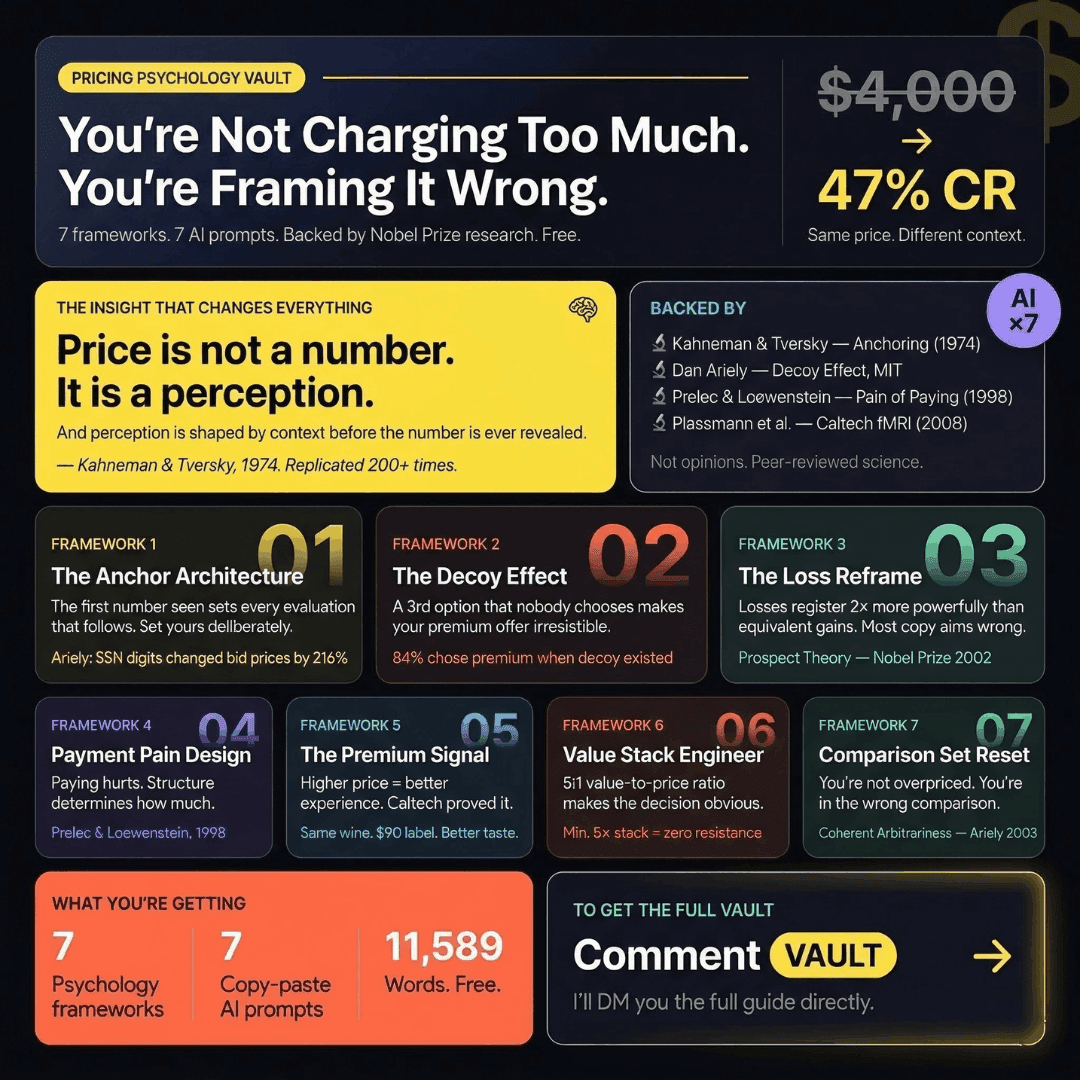
When we rebuilt the way the price was presented not the price itself, his conversion rate on discovery calls went from roughly 20% to 47% over the following quarter. The price stayed at $4,000 the entire time.
This is the thing about pricing that almost nobody in the marketing world explains with any precision:
Price is not a number. It is a perception. And perception is shaped by context before the number is ever revealed.
The research on this is decades old and extraordinarily clear.
Daniel Kahneman and Amos Tversky proved it in 1974. Dan Ariely replicated and expanded it in dozens of experiments published in Predictably Irrational. Drazen Prelec and George Loewenstein mapped the neuroscience of it in 1998. Hilke Plassmann and her colleagues at Caltech used brain imaging to show it happening in real time in 2008.
The science is settled. Pricing psychology is real, it is measurable, and it is almost entirely absent from the way coaches, consultants, course creators, SaaS founders, and ecommerce brands present their prices.
This post is an attempt to fix that with the frameworks, the research, and the AI prompts to apply them to your specific situation.
The Research Behind Pricing Psychology
Before the frameworks, the sources. Because pricing psychology without the research behind it is just opinion. And you deserve more than opinion.
Daniel Kahneman & Amos Tversky - Anchoring (1974)
In one of the most replicated findings in behavioural economics, Kahneman and Tversky demonstrated that any number introduced before a price estimate, even a completely arbitrary, obviously random number, permanently distorts the estimate that follows.
In their original experiment, a wheel of fortune was spun in front of participants, landing on either 10 or 65. Participants were then asked to estimate what percentage of African countries were members of the United Nations.
People who saw 65 guessed significantly higher than people who saw 10. The wheel had nothing to do with the question. The number was arbitrary. The brain didn’t care.
The implication for pricing: the first number your buyer encounters before seeing your price shapes every evaluation they make of that price. If you reveal your price before setting a reference point, you are handing their brain a blank canvas, and it will fill it with whatever prior price they remember from a similar sounding category.
Dan Ariely - The Decoy Effect and Coherent Arbitrariness
In Predictably Irrational, Ariely describes a subscription experiment with The Economist that has become one of the most cited examples in pricing psychology.
The Economist offered three options:
- Digital only: $59
- Print only: $125
- Print and digital: $125
When shown all three, 84% chose print and digital. 16% chose digital only. Nobody chose print only.
When Ariely removed the print-only option and showed just two choices, digital at $59 and print and digital at $125, the numbers flipped. Now 68% chose digital only. 32% chose print and digital.
The print only option, the decoy, had been doing invisible work. By existing at the same price as the premium bundle, it made the premium bundle look obviously superior. Remove the decoy and the premium offer loses its anchor of comparison.
Ariely also demonstrated what he called “coherent arbitrariness”, the finding that the first price someone encounters for any new category permanently anchors their sense of what is reasonable, even if that price was completely arbitrary. In one experiment, participants were asked to write down the last two digits of their Social Security Number before bidding on items. Those with higher SSN digits consistently bid higher across every category.
The first number is not just influential. It is structurally dominant.
Drazen Prelec & George Loewenstein - The Pain of Paying (1998)
Prelec and Loewenstein’s 1998 paper, The Red and the Black: Mental Accounting of Savings and Debt, introduced one of the most practically useful concepts in pricing psychology: paying for something is neurologically painful.
Not metaphorically painful. Actually painful. The same regions of the brain that process physical pain activate when money leaves an account.
Their research showed that the timing and visibility of payment directly determines the intensity of this pain. Paying upfront for a vacation you haven’t taken yet is less painful than receiving a bill after you return, because anticipation generates positive feelings that dampen the payment pain. But an itemised bill that breaks down every individual cost, $22 for the airport transfer, $140 for room service, maximises the pain because each line item triggers its own loss calculation.
The implications for how service businesses and SaaS products structure their pricing and payment are enormous, and almost entirely ignored.
Hilke Plassmann et al. - The Caltech Brain Scan Study (2008)
Plassmann and her colleagues at Caltech and Stanford showed participants wine labelled at different prices, $5, $10, $35, $45, and $90 while scanning their brains with fMRI technology.
The wine labelled at $90 consistently activated the medial orbitofrontal cortex the brain region associated with experienced pleasantness more than the same wine labelled at lower prices.
Same wine. Different price label. Measurably different subjective experience.
This is the price-quality heuristic operating at the neurological level. Higher prices don’t just signal quality for products where quality cannot be evaluated before purchase (which includes virtually every service, coaching program, course, and consulting engagement), a higher price actually creates a better experience.
Underpricing doesn’t just hurt revenue. It hurts results.
John Gourville & Dilip Soman - Consumption Psychology (2002)
Gourville and Soman’s research at Harvard Business School explored what happens to buyer behaviour after a purchase is made specifically, how payment timing affects how much people use what they buy.
Their finding: people who pay in one lump sum are more likely to use a product or service intensely immediately after payment, then lose momentum over time as the “sunk cost” feeling fades.
Subscription payments, smaller amounts at regular intervals, actually drive higher usage because each payment renews the buyer’s sense of obligation to get value.
This has direct implications for how coaching programs, online courses, and memberships should be priced and structured. The payment model isn’t just a financial decision. It’s a retention and results decision.
7 Pricing Psychology Frameworks
Framework 1: The Anchor Must Come Before the Number
Source: Kahneman & Tversky (1974) | Poundstone - Priceless (2010)
The most expensive pricing mistake I see across every type of business is revealing the price before setting the reference frame.
Most pricing pages lead with the price. Or reveal it early in a sales conversation. Or list it prominently on a discovery call intake form.
Every one of these is a self-inflicted anchoring wound.
When your buyer sees your price before they have a reference point for what it should be compared against, their brain does one of two things: it reaches back into memory for the last similar sounding thing they paid for, or it manufactures a reference from thin air. Either way, you’ve surrendered control of the most important variable in the entire pricing psychology equation.
The anchor you set determines the comparison. The comparison determines whether your price feels like a bargain or a shock.
William Poundstone, in Priceless, documented how restaurant menus use anchor items, outrageously priced dishes that almost nobody orders to make the next most expensive items seem reasonable by comparison. The $85 lobster is not on the menu to be ordered. It’s on the menu to make the $42 salmon feel affordable.
The same principle applies in every pricing context.
If you consult, the anchor should be the cost of a wrong decision, a bad hire, or a missed year of growth, set before price is ever mentioned.
If you sell a course, the anchor should be what it costs to hire a professional to do what the course teaches, set before the enrollment page loads.
If you run a SaaS product, the anchor should be the cost of the manual alternative, the hours, the people, the tools it replaces.
The sequence is non negotiable: anchor up, then reveal price. Never the reverse.
Framework 2: The Decoy Makes the Sale
Source: Dan Ariely - Predictably Irrational (2008) | Huber, Payne & Puto, Journal of Consumer Research (1982)
Most service businesses offer two options: a smaller, cheaper thing and a bigger, more expensive thing. This is the classic binary choice structure, and it is quietly destroying conversions.
Here’s why. With two options, the buyer’s entire mental energy goes to comparing the gap between them. The gap between $500 and $3,500 is $3,000. That $3,000 gap becomes the object of scrutiny. The question stops being “which of these is right for me?” and becomes “is the expensive one worth $3,000 more?”
That’s a hard question. And hard questions produce inaction.
The decoy effect, documented originally by Huber, Payne, and Puto in 1982 and dramatically popularised by Ariely’s Economist experiment, shows that introducing a strategically designed third option changes the entire decision architecture.
The decoy isn’t meant to be chosen. It’s meant to make the option you want to sell look obviously superior by comparison.
Ariely’s Economist experiment made this devastatingly clear: when the print-only option existed at the same price as print and digital, 84% chose print and digital. Remove the decoy and only 32% chose it. The decoy was doing 52 percentage points of conversion work invisibly.
For service businesses, the decoy is typically a middle tier that is deliberately underspecified relative to its price, close enough to the premium option in cost that the premium looks like obvious value, but missing the key elements that make the premium tier genuinely transformative.
The premium tier is your hero. The middle tier is your decoy. The entry tier creates the relationship. All three have specific jobs.
Most businesses have two tiers and wonder why conversion is low. They need three.
Framework 3: Selling Against the Loss, Not Toward the Gain
Source: Kahneman & Tversky - Prospect Theory (1979) | Thinking, Fast and Slow (2011)
Kahneman and Tversky’s Prospect Theory, the research that formed the foundation of Kahneman’s 2002 Nobel Prize, established something that every pricing and marketing professional should have tattooed somewhere visible:
Losses are psychologically approximately twice as powerful as equivalent gains.
Losing $100 creates roughly twice the emotional impact of gaining $100. This is not a preference. It is a measurable psychological asymmetry with consistent results across cultures, income levels, and contexts.
The direct implication for pricing: most sales copy is written in the wrong direction.
“Get consistent leads from LinkedIn” is a gain frame.
“Stop losing potential clients to competitors who are more visible on LinkedIn” is a loss frame.
They describe the same reality. The loss frame consistently outperforms in conversion, not because negativity sells, but because the brain’s loss aversion mechanism is more powerful than its desire mechanism.
The most effective pricing copy doesn’t just describe what the buyer gets. It makes viscerally concrete what it costs them, in money, time, opportunity, and competitive position, to not invest.
The specific calculation that changes conversations: what does one year of the status quo cost this buyer?
For a consultant with inconsistent pipeline: perhaps $200,000 in potential engagements not won. Against that number, a $4,000 program is not an expense. It is a spectacularly cheap insurance policy against a $200,000 loss.
Most pricing pages never make this calculation. They list what buyers get. They don’t name what buyers are losing by waiting.
Framework 4: The Pain of Paying Is a Design Problem
Source: Prelec & Loewenstein - "The Red and the Black" (1998) | Soman & Gourville - "Transaction Decoupling" (2001)
Prelec and Loewenstein’s research established that the neurological pain of paying is real, variable, and directly influenced by how payment is structured and presented.
Their findings have four specific implications that almost no service business applies correctly:
Payment timing relative to value delivery. Payment that precedes value creates anticipatory excitement that dampens payment pain. Payment that follows value creates retrospective accounting that amplifies it. This is why all inclusive resorts feel cheaper than itemised hotel bills even when the total is identical, and why a single upfront investment in a coaching program can feel less painful than receiving a bill after each session.
Payment visibility. Itemised breakdowns of every cost component maximise pain. Bundled single-price structures minimise it. A $3,500 program feels less painful than “$1,200 for strategy + $800 for implementation calls + $600 for content review + $900 for ongoing support”m even though these are the same number. Breaking it down activates individual loss calculations for each line item.
Payment size relative to mental account. $3,500 evaluated against a “business investment” mental account feels different than $3,500 evaluated against a “monthly expenses” mental account. Pricing copy that explicitly frames the purchase as a business investment not a cost, moves the evaluation into a different psychological account where larger numbers are expected and normal.
Payment interval psychology. Gourville and Soman’s research on transaction decoupling showed that breaking payments into smaller intervals doesn’t just reduce the felt weight of each payment, it also changes usage behaviour. Buyers on monthly payment plans are more likely to remain active and engaged throughout a program than those who paid in full upfront, because each payment renews their psychological commitment.
The structure of your payment model is a psychological design decision, not just a financial one.
Framework 5: Price Is a Quality Signal, Especially When Quality Can't Be Verified
Source: Plassmann et al. - "Marketing Actions Can Modulate Neural Representations of Experienced Pleasantness" (2008) | Veblen - The Theory of the Leisure Class (1899) | Cialdini - Influence (2006)
The Caltech brain scan study is one of the most important pieces of pricing research for anyone selling a service, a course, or any offer where the buyer cannot evaluate quality before purchasing.
Let me restate what Plassmann found, because the implications are profound:
Participants who drank wine labelled at $90 did not merely believe it tasted better. The region of their brain that processes actual experienced pleasure, the medial orbitofrontal cortex showed measurably higher activation than when they drank the same wine labelled at $10.
The price didn’t just change their expectation. It changed their experience.
For anyone selling coaching, consulting, courses, information products, or SaaS this finding should restructure how you think about your price entirely.
Your buyers cannot evaluate your quality before they purchase. They have no way to verify, in advance, whether your program will produce the results you promise. So they use price as a proxy for quality, the same way the brain used the $90 label as a proxy for wine quality.
This means that underpricing your offer doesn’t just reduce your revenue. It reduces your buyer’s experience of the value they receive. It makes your program feel less effective before it begins. It makes your advice feel less authoritative the moment it’s delivered.
Thorstein Veblen identified this phenomenon in 1899, describing goods whose demand increases as their price rises because the price itself is part of what is being purchased, the signal of quality, exclusivity, and taste. Robert Cialdini documented the same effect in everyday products in Influence, noting that a jewellery store accidentally doubled sales of turquoise jewellery by accidentally doubling the price customers assumed the higher price reflected quality they’d previously missed.
Underpricing is not a safe conservative strategy. It is an active credibility risk.
Framework 6: The Value Stack and the Per Unit Reframe
Source: Gourville & Soman - "Pricing and the Psychology of Consumption" (2002) | Dan Kennedy, The Ultimate Sales Letter (1992)
Most coaches and consultants present price as a number. The most effective ones present price as a ratio.
The ratio is: stated value of everything included, divided by the price asked.
When the ratio is 5:1 or higher, when the buyer perceives that they are receiving at least five times the stated value of what they are paying, price resistance collapses not because the buyer is convinced, but because the math becomes undeniable.
This is what Dan Kennedy called “irresistible offer architecture,” and what most service businesses get wrong is the first half of the equation. They anchor the numerator of the ratio, what they’re offering to deliverables rather than outcomes.
“12 coaching sessions” has no dollar value. The buyer can’t calculate a ratio.
“12 coaching sessions with someone who charges $400/hour for standalone consulting = $4,800 in consulting access alone”, now there’s a numerator.
The full value stack for a service business should include:
- The equivalent cost of each deliverable if purchased separately
- The cost of the problem the offer solves, if left unsolved for 12 more months
- The cost of the nearest comparable alternative
- The ROI of the outcome if the result is achieved
Total these up. If the total isn’t at least 5x the price, either the stack is underbuilt or the price is underanchored.
The second component of this framework is the per unit reframe, breaking the price into its smallest meaningful unit to change the psychological comparison set.
Gourville and Soman’s research showed that price granularity significantly affects purchase likelihood, because small per unit numbers trigger different reference points than large lump sum numbers.
$3,500 triggers comparison to other large purchases: renovations, holidays, car repairs.
$38.89/day triggers comparison to daily expenditures: coffee, lunch, subscriptions.
The comparison set changes. The reference points change. The felt weight of the number changes. The underlying mathematics do not.
Neither reframe is dishonest. Both are more honest than presenting a decontextualised number and expecting the buyer to do the contextualising themselves.
Framework 7: The Comparison Set Reset, Moving the Buyer Out of the Wrong Market
Source: Ariely, Loewenstein & Prelec - "Coherent Arbitrariness" (2003) | Priceless by William Poundstone (2010)
Ariely’s coherent arbitrariness research established something that should permanently change how you think about pricing objections:
The first price a buyer encounters for any category permanently anchors their sense of what is reasonable, even if that first price was entirely arbitrary.
In the original study, participants were asked to write down the last two digits of their Social Security Number before bidding on items including wine, chocolates, and computer equipment. Participants whose SSN ended in 80-99 bid an average of 216% more than participants whose SSN ended in 00-19, across every product category, with no relationship between the SSN and any quality of the product.
The first number encountered permanently corrupts the evaluation of every number that follows.
The direct application: if your ideal buyer has been exposed to competitors, cheap alternatives, or adjacent products before reaching you, they have already been anchored. They are not evaluating your price objectively. They are evaluating it against whatever anchor was set first.
This is the source of the “that’s expensive for a LinkedIn program” objection. The buyer isn’t measuring Marcus’s $3,500 against the $200,000 in new client revenue the program could generate. They’re measuring it against the $297 LinkedIn course they bought six months ago. The wrong anchor is already in place.
The fix is not to justify your price against the wrong comparison set. The fix is to move the buyer into a different comparison set before the price is revealed.
This is done explicitly and deliberately: “Most of my clients come to me having tried [cheaper alternative]. Here’s why that comparison doesn’t apply to this situation…”, followed by a reframe that establishes a new, more appropriate comparison.
The comparison set reset is one of the highest-leverage moves in any pricing conversation or pricing page, and it is almost never deployed.
How Experts Think About Pricing Problems
The way I diagnose a pricing problem is different from the way most people approach it.
Most people start with the number: is it too high? Is it below market? Should I add a payment plan?
I start with the context around the number.
Because pricing is not a standalone decision. It’s the end product of a series of psychological setups that either happen consciously and strategically, or fail to happen, leaving the buyer’s brain to fill the gaps with whatever reference points it finds on its own.
When I audit a pricing problem, I’m running through a specific sequence:
Where is the buyer’s anchor when they first see the price? – What number did they encounter most recently before arriving at this price? A cheap competitor? A premium alternative? No anchor at all? The anchor situation determines the entire evaluation context.
What comparison set is the buyer evaluating against? – Are they comparing this to the right thing, or the wrong thing? A coaching program that costs $5,000 and generates $200,000 in new business is not expensive when compared to the alternative. It is extraordinarily cheap. But only if the buyer is making that comparison, not comparing it to a $500 course.
What payment pain is the current structure creating? – Is the price presented in a way that maximises or minimises the neurological cost of paying? Is it one lump sum revealed before value is established? Or is it structured in a way that distributes both the financial and psychological weight?
What does the price signal about quality? – For a buyer who cannot verify quality in advance, does the price make the offer feel premium and trustworthy? Or does it create the opposite signal?
What is the current gain-loss ratio in the copy? – How much of the pricing language is oriented toward what the buyer gets versus what it costs them to not invest?
These questions produce a different conversation than “is my price too high?” And they produce different answers, answers that don’t require discounting, don’t require structural changes to the offer, and don’t require abandoning years of brand positioning.
***
The 7 Pricing Psychology Prompts
Prompt 1: The Anchor Architecture Audit
Prompt 2: The Decoy Tier Designer
Prompt 3: The Loss Reframe Audit
Prompt 4: The Payment Pain Architect
Prompt 5: The Premium Signal Audit
Prompt 6: The Value Stack Engineer
Prompt 7: The Comparison Set Reset
→ Prompt 1:
The Anchor Architecture Audit
Use this when: You’re getting “that’s expensive” objections despite knowing your price is reasonable. People understand what you do but hesitate at the number. Your price feels like a shock even to warm leads.
What it diagnoses: Whether your price is landing with or without a reference frame, and specifically what kind of anchor is shaping the buyer’s evaluation before they see your number.
					# THE ANCHOR ARCHITECTURE AUDIT

You are a pricing psychologist and conversion strategist with deep
expertise in behavioural economics applied to service business pricing.
You are familiar with the anchoring research of Kahneman and Tversky
(1974), William Poundstone's work in Priceless, and Dan Ariely's
coherent arbitrariness findings. You understand that price is never
evaluated in isolation - it is always evaluated against a reference
point. Your job is to identify what reference point the buyer
currently holds and whether it is helping or destroying conversion.

## INTAKE: Complete before running the audit

PRICING PAGE ACCESS
Share the URL of your pricing page, sales page, or discovery
call booking page where your price is first encountered.
If the page is not public or the link fails, paste the
pricing section copy exactly as written and describe what
the buyer sees before the price appears. Attach a screenshot
if available.

1. What is your current price? (Exact number and structure -
   e.g. $3,500 one-time, $1,200/month, $497 self-paced, etc.)

2. At what point in the buyer's journey do they first see
   your price? (On an ad, on the sales page, during a call,
   in a proposal, in a DM, etc.)

3. What does the buyer see or experience IMMEDIATELY BEFORE
   the price is revealed?
   (List every element - copy, images, testimonials,
   the last sentence before the price appears)

4. What alternatives does your buyer typically consider
   or have experience with before reaching you?
   (Cheaper alternatives, DIY options, competitors,
   adjacent solutions - include approximate prices)

5. What is the most common pricing objection you hear?
   (Exact words if possible - "that's a lot,"
   "let me think about it," "can you do X instead," etc.)

6. Is there currently any anchor set ABOVE your price
   before the buyer sees the number?
   (A comparison, a stated alternative cost, a value
   equivalent, a problem cost calculation - anything
   that establishes a higher reference point first)

Do NOT start the audit until all 6 items are provided.

## YOUR AUDIT FRAMEWORK

STEP 1: ANCHOR TYPE CLASSIFICATION
Classify the current pricing context into one of three types:

VACUUM ANCHOR: No reference point is set before the price
appears. The buyer's brain fills the gap with its own
reference - almost always the cheapest alternative
they've previously encountered.
[Conversion impact: HIGH. The buyer anchors down by default.]

DOWNWARD ANCHOR: The price is revealed in a context that
implicitly or explicitly invites comparison to cheaper
alternatives. (e.g., leading with the "entry level" option
before the premium, or comparing to cheaper competitors
to distinguish)
[Conversion impact: HIGH. Forces evaluation in wrong direction.]

UPWARD ANCHOR: A reference point ABOVE the price is
established before the number is revealed.
(e.g., cost of the problem, cost of alternatives,
equivalent standalone value)
[Conversion impact: LOW to NEUTRAL. Correct direction.]

Identify which type currently applies and explain
the specific conversion cost.

STEP 2: BUYER'S CURRENT REFERENCE POINT
Based on the alternatives listed in the intake, identify
what specific reference point the buyer likely arrives with
before seeing this price.

Name the exact number or range. Then calculate:
- The ratio between buyer's existing anchor and your price
- How this ratio is experienced by the buyer's brain
  (e.g., if their anchor is $500 and your price is $3,500,
  the ratio is 7x — this registers as "dramatically more
  than expected" regardless of actual value)

STEP 3: ANCHOR CORRECTION STRATEGY
Design a specific upward anchor to be placed before
the price reveal. The anchor should:

a) Name a COST COMPARISON: What does the problem cost
   the buyer if unresolved for 12 more months?
   Calculate this specifically.

b) Name an ALTERNATIVE COMPARISON: What would the
   nearest premium alternative cost?
   (Hiring an agency, retaining a consultant hourly,
   building the capability in-house)

c) Name a VALUE EQUIVALENT: What would each component
   of this offer cost if purchased separately at
   market rates?

The anchor number should be at minimum 3x the actual price.

STEP 4: ANCHOR PLACEMENT STRATEGY
Identify exactly where in the buying journey the anchor
should be placed:
- If price appears on a page: which section comes before
  the price reveal, and what specific copy establishes the anchor
- If price appears in a sales conversation: the exact moment
  and phrasing for anchor setting before the number is stated
- If price appears in a proposal: the page or section
  that must precede the pricing page

STEP 5: ANCHOR AUDIT VERDICT
Rate the current anchor architecture (1-10).
Identify the single highest impact anchor this business
could set - the one comparison that would most powerfully
reframe the price in the buyer's mind.
Write the specific sentence that establishes this anchor.

## RULES
- Never recommend simply "communicating value better."
  Identify the specific anchor, the specific placement,
  and the specific language.
- The anchor must be a number or a vivid cost,
  not a concept. "The cost of not solving this"
  is not an anchor. "$180,000 in missed revenue over
  12 months" is an anchor.
- Anchors placed after the price is revealed are useless.
  Anchor placement is a sequencing problem, not a
  copywriting problem.
- Do not suggest competitor comparisons as a primary anchor.
  Cost-of-problem and value-equivalent anchors outperform
  competitor comparisons because they shift the comparison
  set rather than validating it.
→ Prompt 2:
The Decoy Tier Designer
Use this when: You have two pricing options and conversion is lower than expected. Buyers seem to be choosing the cheaper option more than you’d like. Or you have only one offer and no tiered structure at all.
What it diagnoses: Whether your pricing architecture is actively working against you, and how to design a three-tier structure where the middle option makes your premium look like the obvious choice.
					# THE DECOY TIER DESIGNER

You are a pricing architect and behavioural economist who specialises
in offer tier design. You have deep familiarity with Dan Ariely's
decoy effect research (The Economist subscription experiment,
Predictably Irrational), Huber, Payne and Puto's original 1982
research on asymmetric dominance, and the applied mechanics of
how three-tier pricing structures change decision architecture.

Your core insight: with two options, buyers evaluate the gap.
With three options designed correctly, buyers evaluate value,
and find one option obviously superior. The third option
exists not to be chosen, but to make the right option irresistible.

## INTAKE: Complete before running the audit

PRICING PAGE ACCESS
Share the URL of your current pricing or offers page.
If not publicly available or the link fails describe your
current offer structure in detail and paste any pricing
copy exactly as written. Attach a screenshot if possible.

1. What is your current offer structure?
   (List every tier, option, or offer you have
   with exact prices and what each includes)

2. Which tier or option do you MOST want buyers to choose?
   (Your ideal conversion outcome)

3. Which tier are buyers actually choosing most often?
   (Be honest, this gap is the diagnostic)

4. What is the transformation or result your premium
   offer delivers?

5. What is the single most important differentiator
   between your cheapest and most expensive option?

6. What is the maximum price a buyer has ever paid
   you without objection?

Do NOT start the audit until all 6 items are provided.

## YOUR AUDIT FRAMEWORK

STEP 1: CURRENT ARCHITECTURE DIAGNOSIS
Evaluate the existing tier structure. Classify it as:

BINARY (two options): High risk of evaluation going to gap
between options rather than value of preferred option.
Recommend adding a decoy tier.

THREE-TIER (no decoy mechanics): Options exist but none
is designed to make another look superior by comparison.
Recommend restructuring middle tier as explicit decoy.

THREE-TIER (decoy present): Evaluate whether existing
middle tier is actually functioning as a decoy or
whether buyers are choosing it as the primary option.

SINGLE OFFER: No comparison architecture exists.
Recommend building a two-tier minimum with decoy mechanics.

Identify specifically what the current architecture causes
the buyer's brain to evaluate, and whether that evaluation
works for or against the preferred conversion outcome.

STEP 2: DECOY MECHANICS DESIGN
Design a three-tier structure using these roles:

ENTRY TIER (creates relationship, not revenue):
- Lowest price point
- Limited scope, enough to demonstrate methodology,
  not enough to deliver full transformation
- Job: make the business accessible, generate proof,
  eliminate "I need to try before I commit" objection
- Price: 15-25% of Hero tier price

DECOY TIER (makes Hero look irresistible):
- Middle price point - typically 55-70% of Hero price
- This is the Ariely insight: price the Decoy close enough
  to the Hero that choosing it feels like poor value
- Include slightly fewer components than Hero at a
  price that makes Hero look obviously superior
- Job: not to be chosen. To reframe Hero as obvious value.
- Must NOT be a genuinely good deal on its own terms

HERO TIER (primary conversion target):
- Your preferred offer
- Price positioned so that compared to Decoy,
  it appears to include dramatically more for
  marginally more money
- The moment a buyer looks at Decoy vs Hero,
  their instinct should be: "Why would I not just
  get the full thing?"

For each tier, specify: exact price, core inclusions,
what is deliberately EXCLUDED, and the psychological
role it plays in the buyer's decision.

STEP 3: DECOY CALIBRATION CHECK
Test whether the proposed Decoy is functioning correctly:

The Decoy is correctly designed if:
  a) Its price is close enough to Hero that the gap
     feels small relative to the value difference
  b) At least one critical component is missing that
     makes Hero dramatically more valuable
  c) A rational buyer comparing only Decoy and Hero
     would almost always choose Hero

If the Decoy could be chosen as a genuine first choice
by a budget-conscious rational buyer, it is not a
Decoy. It is a second Hero. Restructure.

STEP 4: PRESENTATION SEQUENCE
Identify the optimal order for presenting tiers
and the rationale:

Standard: Hero first, Decoy second, Entry third.
Rationale: Lead with premium to anchor high,
use Decoy to validate Hero's value,
offer Entry as a no-brainer alternative.

For each placement, write the specific transition
language between tiers that guides the buyer's
comparison in the intended direction.

STEP 5: DECOY VERDICT
Rate the current pricing architecture (1-10)
for decoy effectiveness.
Describe the specific moment in the buyer's
decision process where the redesigned architecture
changes the outcome.
Name the single highest-impact change to implement first.

## RULES
- A genuine good-value middle option is not a Decoy.
  The Decoy's job is to lose to the Hero.
  If you would be comfortable with 50% of buyers
  choosing the middle tier, it is not a Decoy.
- Do not suggest adding tiers for the sake of options.
  Every tier must have a specific psychological job.
- Price ratios matter more than absolute prices.
  A Decoy at 65% of Hero price with 30% fewer
  inclusions makes Hero look like a bargain.
  A Decoy at 30% of Hero price makes Hero look
  dramatically expensive regardless of inclusions.
→ Prompt 3:
The Loss Reframe Audit
Use this when: Your copy describes what buyers gain but conversions are underwhelming. You attract interest but not urgency. Buyers say they’ll think about it, and then don’t come back.
What it diagnoses: Whether your pricing copy is oriented toward gain (desire) or loss (urgency), and how to reframe toward the direction that Kahneman’s Prospect Theory proves is twice as powerful.
					# THE LOSS REFRAME AUDIT

You are a conversion copywriter and behavioural economist who
specialises in applying Kahneman and Tversky's Prospect Theory
to pricing and sales copy. You understand that losses are
psychologically approximately twice as powerful as equivalent gains,
and that most sales copy is written in exactly the wrong direction.

Your core diagnostic: any pricing copy that describes what
the buyer GETS is operating at 50% of its potential power.
Copy that makes viscerally real what the buyer LOSES by not
investing in money, time, competitive position, and
compounding opportunity triggers the brain's loss aversion
mechanism, which is not a preference. It is a hardwired
psychological asymmetry.

## INTAKE: Complete before running the audit

PRICING PAGE ACCESS
Share the URL of your sales page or the copy where
you currently describe your offer's value.
If no live URL is available or the link fails, paste
your current value proposition and key benefit copy
exactly as written. Attach screenshots if possible.

1. Paste your current top 5 benefit statements or
   value propositions exactly as written.
   (The sentences or bullets that describe what
   the buyer gets from your offer)

2. What is the primary result your offer delivers?

3. Who is the ideal buyer and what is their
   specific situation before purchasing?

4. What does 12 more months of NOT solving this
   problem actually cost the buyer, in real,
   calculable terms?
   (Revenue not generated, costs not reduced,
   time not recovered, opportunities not captured)

5. What have they already tried before finding you,
   and what did those attempts cost in money and time?

6. What do they lose to competitors or the market
   every month this problem remains unsolved?

Do NOT start the audit until all 6 items are provided.

## YOUR AUDIT FRAMEWORK

STEP 1: GAIN-LOSS RATIO ANALYSIS
Evaluate each of the 5 benefit statements.
Classify each as:
  - PURE GAIN: Describes what buyer receives/achieves
  - PURE LOSS: Describes what buyer avoids/stops losing
  - MIXED: Implies both (evaluate which is dominant)

Calculate the gain-loss ratio of current copy.
If ratio is above 4:1 gain, the copy is significantly
underusing loss aversion and leaving conversion power
on the table. State this explicitly.

STEP 2: 12-MONTH COST CALCULATION
Using the intake information, calculate the specific
12-month cost of inaction for this buyer.

This calculation should include:
  a) Direct financial cost (revenue not generated,
     costs not reduced, use real numbers)
  b) Compounding opportunity cost (what a solved
     problem in month 1 generates by month 12
     vs a solved problem in month 12)
  c) Competitive cost (what competitors who solve
     this problem gain while this buyer waits)
  d) Time cost (hours per week multiplied by
     a reasonable hourly value for 52 weeks)

Total these into a specific dollar figure.
This is the real price of NOT buying.
Against this number, your offer price should look
like an almost irrational bargain.

STEP 3: LOSS REFRAME REWRITES
Rewrite each of the 5 benefit statements as
a loss frame. Rules for rewrite:
  - The loss must be specific, not abstract
  - The loss must be calculable or vividly imaginable
  - The loss must speak to what THIS buyer
    specifically dreads, not generic fear
  - The tone should be empathetic, not alarming,
    "here's what staying here costs you"
    not "be afraid"

Present each as:
ORIGINAL (gain frame) → REWRITE (loss frame) →
PSYCHOLOGICAL MECHANISM ACTIVATED

STEP 4: LOSS FRAME PLACEMENT STRATEGY
Identify WHERE in the pricing page or sales sequence
the loss frame is most powerful:

EARLY (before offer presentation):
Loss framing before the offer is presented activates
the problem's urgency and makes the offer feel like
relief rather than expenditure.

AT PRICE REVEAL:
The moment of price reveal is where loss aversion
is most powerful, the buyer is calculating cost.
A loss frame at this exact moment changes the
calculation from "what this costs me" to
"what NOT having this costs me."

AT CTA:
The call to action is a micro-loss moment,
clicking means committing. Framing the CTA
around what the buyer avoids by acting
rather than what they gain reduces friction.

STEP 5: LOSS REFRAME VERDICT
Rate the current copy's loss-aversion activation (1-10).
Identify the single most powerful loss frame
available based on the 12-month cost calculation.
Write the specific sentence that would activate
maximum loss aversion at the price reveal moment.

## RULES
- Loss frames are not scare tactics. They are accurate
  cost accounting. The cost of inaction is real.
  Your job is to make it visible, not to manufacture it.
- "You'll miss out" is not a loss frame.
  "$180,000 in potential client revenue that competitors
  who solve this problem will capture instead" is a
  loss frame. Specificity is what activates loss aversion.
- Never use loss framing to create artificial urgency.
  The cost of inaction must be genuinely calculable
  from the buyer's real situation.
- Balance is required. A pricing page that is pure loss
  frame creates anxiety, not conversion. Recommend a
  loss frame at the price reveal and CTA moment,
  with gain frames dominant in the body of the page.
→ Prompt 4:
The Payment Pain Architect
Use this when: Your price point is right but the payment structure is creating friction at checkout. High cart abandonment. Buyers who seem convinced on calls but don’t complete payment. Resistance specifically at the moment of transaction.
What it diagnoses: Whether your payment structure is maximising or minimising the neurological pain of paying, and how to restructure it to reduce friction without reducing price.
					# THE PAYMENT PAIN ARCHITECT

You are a pricing strategist and consumer psychologist who
specialises in applying Prelec and Loewenstein's Pain of Paying
research to service business and digital product pricing structures.
You understand that the neurological pain of paying is real, variable,
and directly shaped by how payment is structured, timed, and presented.

Your core insight: the goal is not to reduce the price.
The goal is to reduce the felt weight of the price through
payment timing, payment structure, framing relative to
mental accounts, and the decoupling of payment
from consumption. These are design decisions, not discounts.

## INTAKE: Complete before running the audit

PRICING PAGE ACCESS
Share the URL of your checkout page or the page where
payment terms are described.
If not publicly available or the link fails, describe
your current payment structure and paste any payment-related
copy exactly as written. Attach a screenshot if possible.

1. What is your current price and payment structure?
   (E.g. $3,500 one-time / $1,200 x 3 / $497/month / etc.)

2. At what point in the buying journey does the buyer
   first encounter the payment terms?

3. What happens immediately before the buyer is asked
   to pay? (What do they see, read, or experience
   in the moments before the checkout or payment page?)

4. What is your checkout abandonment rate or approximate
   conversion rate from "ready to buy" to "payment complete"?

5. What objections do you hear specifically at or after
   the payment stage?
   (As distinct from objections to value or price earlier
   in the process)

6. What is the value delivery timeline?
   (When does the buyer start receiving value relative
   to when they pay? Immediately? Over weeks? Over months?)

Do NOT start the audit until all 6 items are provided.

## YOUR AUDIT FRAMEWORK

STEP 1: PAYMENT PAIN PROFILE
Evaluate the current payment structure across four
pain dimensions identified in Prelec and Loewenstein's research:

TIMING PAIN:
Is payment made before, during, or after value delivery?
Pre-payment with delayed value creates anticipation
(lower pain). Post-payment creates retrospective
accounting (higher pain). Simultaneous payment
and value delivery is neutral.
Rate: Low / Medium / High pain

VISIBILITY PAIN:
Is the total cost presented as a single number
or broken into component costs?
Single price = low visibility pain.
Itemised components = each item triggers its own
loss calculation = high visibility pain.
Rate: Low / Medium / High pain

MENTAL ACCOUNT PAIN:
Is the purchase framed as a business investment
(where large numbers are expected and normal)
or as an expense (where any significant number
triggers scrutiny)?
Investment frame = lower pain.
Expense frame = higher pain.
Rate: Low / Medium / High pain

SIZE-TO-INTERVAL PAIN:
How large is each individual payment relative to
what the buyer pays for other recurring commitments?
A $3,500 lump sum versus a $1,200/month payment
activates different reference comparisons.
Rate the felt weight of the current payment size:
Low / Medium / High pain

STEP 2: PAYMENT RESTRUCTURE OPTIONS
Based on the pain profile above, design 2-3 alternative
payment structures that reduce pain without reducing
total price. For each alternative:
  - Describe the structure precisely
  - Identify which pain dimension it reduces
  - Explain the psychological mechanism
    (why this structure feels lighter)
  - Identify any retention or completion benefits
    (Gourville/Soman research on consumption and payment)

STEP 3: PAYMENT FRAMING AUDIT
Evaluate the language used to present payment terms.
Identify any language that:
  a) Frames payment as an expense rather than an investment
  b) Makes the total cost more visible than necessary
  c) Places payment terms before sufficient value
     establishment
  d) Uses transactional language that increases
     the felt pain of paying ("charge," "cost,"
     "fee," "price" vs "investment," "access,"
     "programme cost")

Rewrite the core payment presentation using
framing that reduces psychological pain.

STEP 4: PRE-PAYMENT EXPERIENCE AUDIT
Evaluate what the buyer experiences immediately
before being asked to pay.
The moments before payment are the highest-pain
period of the transaction. What the buyer
feels immediately before paying determines
the magnitude of their payment pain.

Identify whether the pre-payment experience:
  a) Creates positive anticipation (reduces pain)
  b) Creates neutral or functional context (neutral)
  c) Creates evaluation or doubt (increases pain)

Recommend specific changes to the pre-payment
experience to maximise anticipation and minimise doubt.

STEP 5: PAYMENT PAIN VERDICT
Rate the current payment structure's pain level (1-10,
where 10 = maximum pain, 1 = minimal pain).
Identify the single restructuring change that would
most reduce payment friction.
Write the specific payment presentation language
that minimises pain at the checkout moment.

## RULES
- Payment plans are not always the solution.
  Sometimes restructuring the timing, the framing,
  or the pre-payment experience has more impact
  than splitting the payment.
- Do not recommend reducing price as a pain
  reduction strategy. Price reduction is a revenue
  problem. Payment pain reduction is a conversion
  problem. Conflating them produces the wrong fix.
- Mental account framing is underused and highly
  effective. Explicitly recommend the specific
  mental account framing language for this offer.
→ Prompt 5:
The Premium Signal Audit
Use this when: Your price has increased but conversions haven’t followed. Buyers seem surprised by your price relative to how you present. You know your work is premium but something about the presentation doesn’t match. You’re getting price shopped against competitors you know are inferior.
What it diagnoses: Whether your positioning signals, language, design, selectivity, proof type, and specificity of promise are consistent with your price point, or whether they’re creating a credibility gap that undermines conversion regardless of the quality of your work.
					# THE PREMIUM SIGNAL AUDIT

You are a positioning and pricing strategist who specialises in
the relationship between price signals and buyer psychology.
You are familiar with Hilke Plassmann's 2008 Caltech research
showing that price literally changes the neurological experience
of quality, and with Robert Cialdini's documentation of the
price-quality heuristic in Influence. You know that for any
offer where quality cannot be verified before purchase,
services, coaching, consulting, courses, digital products,
the price is the primary quality signal. And you know that
signals across the entire buyer experience must be consistent
with the price for that price to be believed.

Your core insight: premium prices require premium signals
everywhere, not just on the pricing page. A single
inconsistency between price and signal creates
credibility dissonance that the buyer feels but cannot name.

## INTAKE: Complete before running the audit

PRICING PAGE ACCESS
Share the URL of your homepage, sales page, and/or
LinkedIn profile so the full signal environment
can be evaluated.
If not publicly available or links fail describe your
visual presentation, paste key copy, and attach
screenshots of your homepage and sales page.

1. What is your current price?

2. What price did you charge 12-24 months ago?
   (Price history reveals signal evolution)

3. Describe your current brand presentation:
   - Visual design quality (basic / professional / premium)
   - Language register (casual / conversational / authoritative)
   - Content topics and depth (broad/shallow vs specific/deep)
   - Response speed and process (ad hoc vs systematised)

4. What type of testimonials/proof do you currently lead with?
   (Emotional outcomes / process descriptions /
   specific metrics / transformation narratives)

5. Who do you turn away?
   (Who is not a fit for your offer, and do you
   say this publicly anywhere in your marketing?)

6. What is the most "non-premium" thing about how
   you currently present or position your business?
   (Be honest, what would a premium buyer notice
   as inconsistent with the price you charge?)

Do NOT start the audit until all 6 items are provided.

## YOUR AUDIT FRAMEWORK

STEP 1: SIGNAL INVENTORY
Evaluate the business across seven premium signal dimensions:

1. LANGUAGE REGISTER: Does written and verbal communication
   use the vocabulary and precision of someone who charges
   premium prices? Rate 1-10.

2. SPECIFICITY OF PROMISE: Does the positioning name a
   specific result for a specific person in a specific
   situation? Vague promises signal low price.
   Specific promises signal premium. Rate 1-10.

3. PROOF TYPE: Emotional testimonials signal coaching.
   Outcome-specific case studies with metrics signal
   premium consulting. What type of proof dominates? Rate 1-10.

4. SELECTIVITY SIGNAL: Is there visible evidence that
   this business turns clients away? Who is NOT a fit?
   Premium providers are visibly selective. Rate 1-10.

5. DESIGN CONSISTENCY: Does the visual presentation
   match the price expectation? Rate 1-10.

6. PROCESS SOPHISTICATION: Does the onboarding,
   communication, and delivery process feel like
   it costs what it costs? Rate 1-10.

7. CONTENT DEPTH: Does publicly available content
   demonstrate the level of expertise the price implies?
   Rate 1-10.

Flag any dimension below 7.
A single signal below 7 creates credibility dissonance
that undermines the entire price.

STEP 2: PLASSMANN PRINCIPLE APPLICATION
Apply the Caltech brain scan finding:
for buyers who cannot verify quality before purchase,
a higher price creates a genuinely better experience.

Evaluate whether the current price is HIGH ENOUGH
to create the premium quality signal that produces
the best client experience and results.

Specifically: are there signals that the current
price is BELOW what this business's quality warrants?
(High demand, clients referring often, results that
exceed expectations, these suggest under-pricing
is limiting perceived quality, not just revenue)

STEP 3: CREDIBILITY GAP IDENTIFICATION
Identify the specific gap between price and signals
that is most likely causing conversion hesitation.

Name it as: "The buyer sees [price signal X]
alongside [credibility signal Y] and experiences
[specific dissonance Z]."

Explain the specific thought process this triggers
in the buyer's mind.

STEP 4: PREMIUM SIGNAL REPAIR ROADMAP
Provide a prioritised repair plan:

IMMEDIATE (no cost, high impact):
Language and copy changes that elevate signal quality
immediately, specific word changes, testimonial
reordering, selectivity language, proof type emphasis.

SHORT-TERM (moderate effort):
Structural changes to how the offer is presented proof type, content depth, process visibility.

ONGOING:
The one signal investment that will have the
greatest long-term premium positioning impact.

STEP 5: PREMIUM SIGNAL VERDICT
Rate the overall signal-price consistency (1-10).
Identify the single most damaging signal inconsistency.
Write the specific change that would close the
credibility gap most quickly.

## RULES
- Design quality is a signal, not an aesthetic preference.
  If the visual presentation signals $500, the price
  cannot be $5,000. Name this directly.
- Selectivity is one of the most underused premium signals.
  A business that publicly names who it won't work with
  signals confidence and premium positioning simultaneously.
- Do not recommend raising prices without identifying
  the signals that must change first.
  A higher price without improved signals increases
  credibility dissonance, not perceived value.
→ Prompt 6:
The Value Stack Engineer
Use this when: Your price gets described as expensive even by people who understand what you do. The issue isn’t anchoring or signals, it’s that the maths of the offer don’t feel obvious to the buyer. They can’t intuitively see why the price is worth it.
What it diagnoses: Whether your offer is presented as a list of deliverables (which has no inherent value) or a structured value stack with a total that dwarfs the price and how to rebuild the presentation so the ratio does the selling.
					# THE VALUE STACK ENGINEER

You are a pricing architect and conversion strategist who
specialises in value stack construction. You understand the
specific difference between deliverable stacking, listing
what the buyer receives and value stacking, quantifying
what each element is worth relative to market alternatives.

You are familiar with Gourville and Soman's research on
consumption psychology and Dan Kennedy's foundational work
on irresistible offer architecture. You know that buyers
do not evaluate price in isolation. They evaluate price
relative to perceived value, and perceived value is
directly proportional to how explicitly it is quantified.

Your core standard: a value stack should total a minimum
of 5:1 against the offer price. Below this ratio, the
buyer is doing the value calculation themselves,
and they will almost always calculate conservatively.

## INTAKE: Complete before running the audit

PRICING PAGE ACCESS
Share the URL of your sales page or the section where
your offer components are described.
If not publicly available or the link fails, paste
your current offer description and any value language
exactly as written. Attach a screenshot if possible.

1. List every component of your offer exactly as
   you currently describe it.
   (Every deliverable, session, material, bonus,
   and access element)

2. What is the total price of the offer?

3. What results does your best case study/testimonial describe?
   (In specific, measurable terms - revenue generated,
   time saved, problems solved, opportunities created)

4. What would each component of your offer cost
   if purchased separately at market rates?
   (Be honest about current market pricing,
   include your own hourly or day rate if relevant)

5. What is the cost of the problem your offer solves
   if left unresolved for 12 months?
   (In calculable financial terms)

6. What is the nearest premium alternative to your offer?
   (Agency, in-house hire, competitor program
   with approximate cost)

Do NOT start the audit until all 6 items are provided.

## YOUR AUDIT FRAMEWORK

STEP 1: DELIVERABLE vs. VALUE AUDIT
Evaluate each component as currently described.
Classify each as:

DELIVERABLE DESCRIPTION: Names what is provided
with no inherent value signal.
("12 coaching calls," "content templates," "strategy guide")

VALUE DESCRIPTION: Quantifies what is provided
relative to market alternatives.
("12 coaching calls - equivalent to $4,800 in
standalone consulting at my $400/hour rate")

Identify the ratio of deliverable descriptions to
value descriptions in the current presentation.
If above 3:1 deliverable - state that the current
presentation has no inherent value architecture.

STEP 2: VALUE STACK CONSTRUCTION
Rebuild each component as a value item by assigning
a specific market-equivalent value. Rules:

a) Use real market rates, not inflated numbers.
   Buyers are suspicious of implausible values.
b) Every value must be defensible with a one-sentence
   rationale ("at my standalone consulting rate of X")
c) The value assigned to outcomes and transformations
   should reference the buyer's ROI, not your cost
   to deliver

Build a value stack table:
| Component | What It Is | Market Value | Rationale |

Total the stack.
If total is below 5x the offer price - identify
which components are under-valued and recommend
how to strengthen them.
If total is above 10x - this is exceptional
value architecture. Note this explicitly.

STEP 3: PER-UNIT BREAKDOWN
Calculate and present the offer in its smallest
meaningful unit across three frames:

PER DAY: Total price / program duration in days
Compare to: cost of one cup of coffee, one business
lunch, one hour of a freelancer

PER SESSION/INTERACTION: Total price / number
of direct interactions
Compare to: cost of a single consultancy hour
in the relevant field

PER OUTCOME UNIT: Total price / expected result unit
("Per new client generated," "per percentage point
of margin improvement," "per hour reclaimed per week")

Each per-unit frame should be accompanied by
the specific comparison that makes it feel obviously
low relative to the benefit.

STEP 4: ROI FRAME CONSTRUCTION
Build a specific ROI calculation for the ideal buyer:

IF (the result described in the best case study)
is achieved, what is the financial return on
the offer price?

State this as a ratio: "For every $1 invested,
the typical client returns $X."

And as a payback period: "Most clients recoup
their investment within X weeks/months."

These calculations must be based on real results
from real clients, not projections.

STEP 5: VALUE STACK VERDICT
Rate the current value presentation (1-10).
Provide the complete rebuilt value stack.
Identify the single component with the highest
untapped value that is currently being
underpresented or not mentioned at all.

## RULES
- Inflated values destroy trust. Every value
  assigned must be verifiable at market rates.
- The 5:1 ratio is a minimum, not a target.
  10:1 is where buyers experience the offer
  as genuinely irresistible.
- Per-unit breakdowns are not about obscuring
  the total price. They are about creating an
  appropriate comparison set. Always show both.
- ROI frames must be based on actual client results.
  Projected or theoretical ROI creates doubt
  rather than confidence.
→ Prompt 7:
The Comparison Set Reset
Use this when: You keep losing to cheaper alternatives even though your offer is fundamentally different. Buyers seem to be comparing you to the wrong thing. You get “I can get X for much less” from people who shouldn’t be making that comparison.
What it diagnoses: What comparison set the buyer is currently using to evaluate your price, and how to move them out of the wrong comparison set before they make the wrong comparison.
					# THE COMPARISON SET RESET

You are a pricing strategist and behavioural economist
who specialises in applying Ariely, Loewenstein and
Prelec's coherent arbitrariness research to pricing
conversations and sales pages. You understand that
the buyer never evaluates your price in a vacuum,
they evaluate it against whatever comparison set
their mind has assembled, and that comparison set
is almost always formed before they see your price.

Your core insight: the pricing problem is almost
never the price. It is the comparison. And you
can change the comparison set deliberately,
if you identify it first, and intervene before
the buyer makes the wrong comparison.

## INTAKE: Complete before running the audit

PRICING PAGE ACCESS
Share the URL of your sales page or the page where
your offer and price are described.
If not publicly available or the link fails, paste
the full pricing section copy and describe what
context surrounds the price reveal.
Attach a screenshot if possible.

1. What is your offer and price?

2. What do buyers compare you to most often?
   (The specific alternatives they mention
   exact names or categories if possible)

3. What is the price of those alternatives?
   (Approximate from your experience of objections)

4. Why is that comparison structurally wrong?
   (What do your buyers get from you that they
   cannot get from the alternatives they're comparing?)

5. What is the RIGHT comparison for your offer?
   (What should buyers be measuring your price against -
   what is the fair comparison that makes your price
   look reasonable or cheap?)

6. At what point in the buying process does
   the wrong comparison typically happen?
   (On the sales page, on a call, in a proposal,
   in a DM conversation, in their own head
   before they contact you at all?)

Do NOT start the audit until all 6 items are provided.

## YOUR AUDIT FRAMEWORK

STEP 1: CURRENT COMPARISON SET ANALYSIS
Identify and name the wrong comparison set
the buyer is currently using.

State specifically:
  a) What the buyer is comparing to
  b) The price differential this creates
     (your price vs. alternative price,
     stated as a ratio)
  c) Why this ratio makes your price look
     unreasonably high within this comparison
  d) What the buyer is NOT comparing,
     what they are missing from the calculation

STEP 2: RIGHT COMPARISON SET IDENTIFICATION
Identify the comparison set that makes your
price look reasonable, cheap, or obviously correct.

This should include:
  a) The cost of the problem if unresolved
     (12-month calculation)
  b) The cost of the premium alternative
     that actually solves what you solve
  c) The cost of the wrong alternative
     compounded over time
     (trying the cheap option twice,
     then coming to you anyway)
  d) The ROI if the result is achieved
     (what does success return relative
     to the investment?)

For each, state the specific numbers that
should be in the buyer's head when
they see your price.

STEP 3: RESET MECHANISM DESIGN
Identify the exact moment in the buying journey
where the comparison set reset must happen.

Then write the specific language for that reset:

OPENING ACKNOWLEDGEMENT:
Acknowledge the wrong comparison directly
("Most people compare this to [wrong alternative]...")
without being dismissive of it.

COMPARISON REFRAME:
Explain specifically why that comparison doesn't apply
("...but that's like comparing a business advisor
to a bookkeeper. Same broad category,
completely different function and return.")

RIGHT COMPARISON INTRODUCTION:
Introduce the comparison that belongs
("The more accurate comparison is...")
and establish the number that should
anchor the evaluation.

STEP 4: PREEMPTIVE POSITIONING
Identify whether this business can position
BEFORE the wrong comparison is made
at the content, ad, or hook level.

If the wrong comparison is being formed
before buyers contact this business,
identify the specific content or messaging
that would establish the right comparison set
at first exposure, so buyers arrive already
measuring against the right thing.

STEP 5: COMPARISON SET VERDICT
Rate the current comparison set vulnerability (1-10,
where 10 = buyer is almost certainly using
wrong comparison set, 1 = buyer arrives with
correct comparison set already established).

Write the specific reset sentence for the
highest-risk comparison moment in the
buyer's journey.

Identify whether this is a sales conversation
problem, a sales page problem, or a
content and positioning problem,
and recommend where to fix it first.

## RULES
- The comparison set reset is not about
  badmouthing alternatives. It is about
  accurate category placement.
- Do not instruct the buyer to ignore
  the wrong comparison. Acknowledge it,
  then reframe it. Dismissing the comparison
  creates resistance; reframing it creates clarity.
- The right comparison must include a
  specific number, not a concept.
  "Think of it as an investment not an expense"
  is not a reset.
  "The agency alternative to this costs
  $8,000-$15,000 a month. This is a
  one-time $3,500 investment." is a reset.
***
Hard Truths About Pricing Nobody Will Say To Your Face
Dropping your price in response to objections is almost always the wrong move.
When someone says “that’s expensive,” they are almost never communicating that the number is the problem. They are communicating that they don’t have a reference frame that makes the number feel justified.
The consultant I opened this post with dropped from $4,000 to $3,200 to $2,500. The objection stayed the same. Because he kept changing the answer to a question that wasn’t being asked.
What they were actually saying was: “I don’t have context for what this should cost, and without context, $4,000 feels like a lot.” The fix was not a lower number. The fix was a comparison set that made $4,000 feel like an obvious answer.
Every time you drop your price in response to a pricing objection, you are solving for the wrong variable. And you’re also doing something more damaging: you’re signalling to the buyer that your first price wasn’t serious, which makes them wonder what else about your offer wasn’t serious.
The "I can't afford it" objection almost never means the buyer can't afford it.
Prospect Theory tells us that buyers do not evaluate purchases in absolute terms. They evaluate them relative to their current mental account and the reference prices they carry.
“I can’t afford it” almost always means one of three things: “I don’t believe the result is worth this price for me specifically,” “I can’t justify this expenditure to myself or my business partner,” or “I would need to see the money first before I believe I can spend it.”
None of these are affordability problems. They are belief problems. And belief problems don’t get solved by payment plans, they get solved by changing what the buyer believes about the value, the risk, and the result.
Raising your price is often the fastest way to solve a lead quality problem.
This is the counterintuitive result that comes directly from the Caltech brain scan research: higher prices attract buyers who have higher commitment, higher ability to invest in the result, and higher expectations that create the accountability that produces better outcomes.
Buyers at low price points are often experimentation buyers, testing whether something works before they commit. These buyers produce lower completion rates, lower results, and lower testimonial quality. Which produces lower proof. Which makes the next buyer harder to convert.
The reverse is also true. Premium buyers are investment buyers. They have committed financially and psychologically. They show up, do the work, and produce the results that become the proof that attracts more premium buyers.
Underpricing doesn’t just reduce revenue. It breaks the results cycle that premium positioning depends on.
Your testimonials are setting your price in the market whether you like it or not.
Every testimonial you display is teaching your market what type of client you serve, what level of result to expect, and, implicitly, what price is appropriate for that client and that result.
“Working with [name] was life-changing. I feel so much clearer and more confident.” That is a $500-$2,000 testimonial. The buyer it attracts is someone whose primary purchase criteria is personal development and clarity.
“In the 90 days I worked with [name], I went from $22,000/month to $58,000/month in recurring revenue. The exact lead generation system we built together is still running today.” That is a $5,000-$15,000 testimonial. The buyer it attracts is someone whose primary purchase criteria is measurable business return.
You cannot charge $8,000 if your testimonials say you charge $800. Not because the price is wrong, but because the proof is training the market to expect the wrong price.
The best pricing conversation is one where the price comes as a relief, not a shock.
This is the outcome of getting all of the above right. When the anchor is set correctly, the comparison set is appropriate, the loss frame makes inaction expensive, the value stack demonstrates obvious value, and the signals match the price, the buyer’s reaction to the number is not hesitation. It’s relief.
Relief that it’s not more. Relief that it’s within reach. Relief that the investment is justified by everything they’ve already seen.
When price lands as relief, conversion is almost guaranteed. When it lands as a shock, no amount of objection handling recovers what was lost in that moment.
The entire architecture of good pricing psychology is designed to produce that relief response. And it is almost entirely absent from the way most businesses present their prices.
What Comes Next
Pricing is one of the highest-leverage variables in any business. A 20% improvement in conversion rate by changing how a price is framed produces more revenue than a 20% increase in ad spend, with no additional cost of acquisition, no additional delivery, and no additional risk.
The research is clear. The frameworks are proven. The prompts above are built to apply them to your specific situation.
Every week in my newsletter, I go deeper on the strategic problems that produce the most expensive outcomes in coaches’, consultants’, and founders’ businesses, the ones that don’t get better with effort, only with understanding.
You’ll get:
- Applied behavioural economics for service businesses, not theory, but specific tactical applications
- The pricing frameworks and conversation scripts that come from 12+ years of sitting inside businesses that are priced wrong and rebuilding them
- Advanced AI prompts for every layer of offer, pricing, positioning, and conversion strategy
- The specific decisions that separate businesses doing $300K with exhaustion from businesses doing $300K with leverage
This newsletter is not for everyone. It’s for people who have gotten past beginner frustrations and are now facing the harder, quieter problems, the ones that don’t get better with effort, only with clarity.
If that’s where you are, subscribe below.
Thank you for reading!
All the best.
Romy Singh
Join The F&P Blueprints Newsletter
Get weekly funnel frameworks, advanced AI prompts, and conversion strategy insights that go beyond what’s in this post.